Materials Spotlight: The Wooden Hierarchical Material
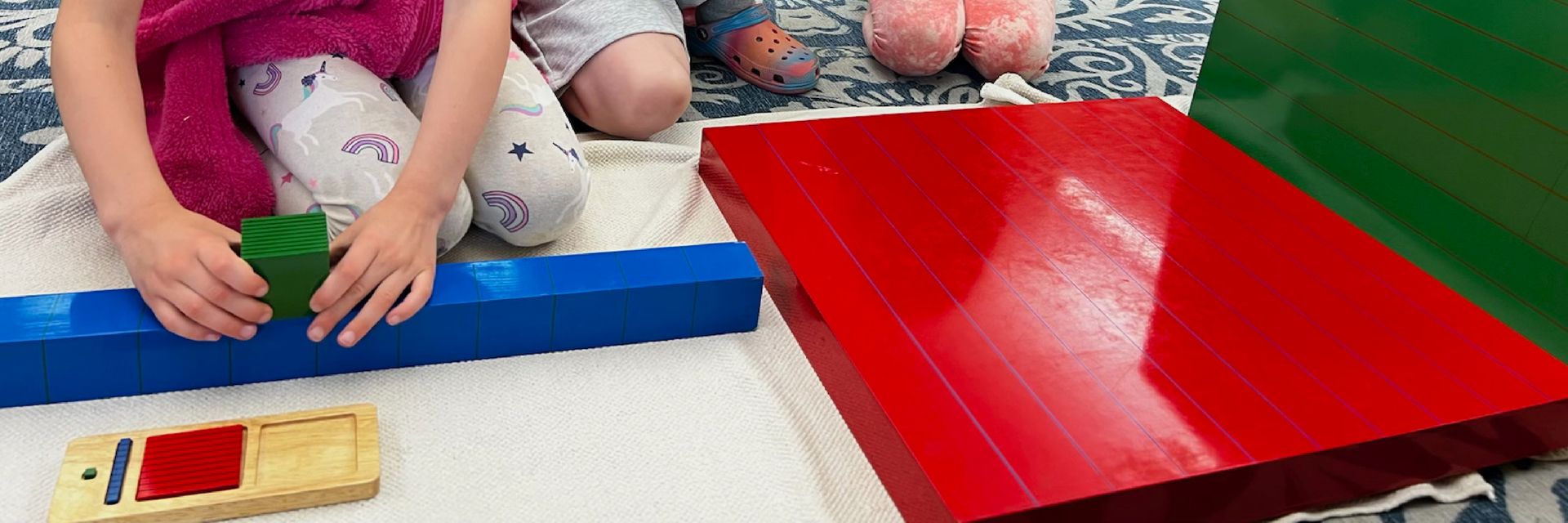
The Wooden Hierarchical Material takes up a great deal of space in our primary and elementary classrooms, and for good reason! This key math material helps children understand the hierarchy of numbers and physically represents units through millions.
The Concrete Material
The Wooden Hierarchical Material comprises cubes, prisms, and squares that vary in size and color according to the different place values they represent. Units are green. Tens are blue. Hundreds are red. This pattern continues throughout the families or categories, so unit thousands are also green, ten thousands are blue, hundred thousands are red, and then unit millions are green. Units are represented as cubes, tens as prisms (or a line of ten units), and hundreds as squares (constructed from ten tens side-by-side). Due to this repeated pattern that is reinforced through shape and color-coding, children can visualize the structure of our decimal system.
The Presentation to Children
When we present the Wooden Hierarchical Material, we first connect with other math materials children have used, like the golden beads and the stamp game. In this way, children can build upon their prior knowledge of place value and how 10 of one category are exchanged for one of the next category (e.g. ten units become one ten).
The material is constructed to reinforce the relationship between base-ten numbers in concrete form. As we place the blue ten bar to the left of the small green unit, we remind children how when ten units get together, they make a ten. We also point to the little green marks on the bar and use the unit to count that ten of the units make up the ten bar. Young children love double-checking this correspondence!
We repeat this process to show how ten of the blue ten bars correspond to the ten sections on the red hundred square. Then how when 10 hundreds get together, they make a thousand. When we place the green thousand cube to the left of the red square, we leave some extra space between them because we are starting a new family (or category). This green thousand cube is units of thousands, and we can continue the process with tens of thousands and hundreds of thousands. Children love getting to the green unit of the millions cube and often want to try to imagine or represent ten million, hundred million, and beyond!
The Many Benefits
Because children can physically explore how ten of the thousand cubes make a line that represents 10,000, just like ten of the unit cubes make a line that represents a 10, they develop a strong understanding of the hierarchical value of numbers and their position in the decimal system. Similarly, they can experience how ten 10,000s make up a 100,000, and ten 100,000s make a million! This physical manipulation helps them better grasp abstract mathematical concepts, such as the process of exchanging, exponential growth, and the concept of powers of ten.
As children develop their number sense, the Wooden Hierarchical Material strengthens their understanding of large numbers. The repetitive and visual nature of the material helps solidify children’s mental image of numbers and place values, making future math concepts easier to grasp.
Children’s Continued Work
When children are first introduced to the Wooden Hierarchical Material, we often play games, asking volunteers to show particular items (e.g., “Can someone show me the 10,000?"). In this way, we activate children’s reasoning minds and draw their attention to connections within the material. Once we ensure that the quantities and names are clear, children often like to explore the material further by considering what comes next after one million, making a connection to geometry (point, line, plane/square), measuring, and even labeling the material with the numeric symbols and written names for the different quantities. Children love to quiz each other as they place the cards showing “one million” or “1,000,000” on the correct item.
Montessori in Practice
This work is great fun for our oldest primary children and youngest elementary students. They love to lay out the materials, explore the relationships, and label the quantities with numeral cards. Children develop an intrinsic love for mathematics in this self-directed learning and discovery process.
The Wooden Hierarchical Material is one of many ways Montessori education helps children develop a deep, intuitive understanding of numbers, place value, and mathematical relationships.
Visit our school to learn more about how Montessori supports strong math skills!