150 Years: The Power of a Story, Part 2
Meagan Ledendecker • October 12, 2020
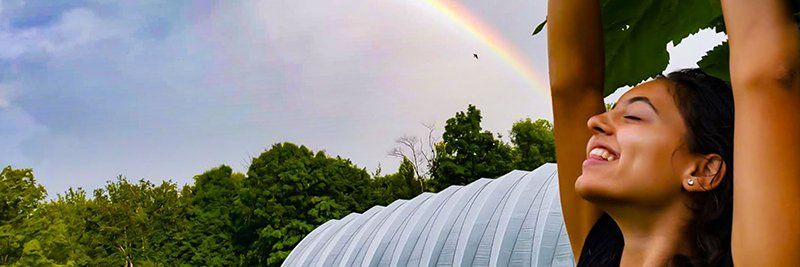
Young woman in front of a greenhouse, rainbow in sky

This article is part of a series that we will share throughout the 2020-2021 school year to celebrate the 150th birthday of Dr. Maria Montessori. Check back often for more posts that reflect on the past, present, and future of Montessori education.


Last month we shared the story of Montessori educator Shawnaly Tabor. This month we highlight the Montessori journey from a different perspective: that of the student. Neshima (17) and Emet (15) Vitale-Penniman are adolescents that began their Montessori primary education at a public Montessori school, and during their lower elementary years transitioned to a private Montessori school. Emet currently attends The Darrow School, where Neshima graduated from this past spring as valedictorian. In addition to their schoolwork, both children work alongside their parents Leah Penniman and Jonah Vitale-Wolff, co-founders of Soul Fire Farm.


Let’s start at the beginning. What are your earliest memories of attending a Montessori school? What did you take away from your time in a primary class that you look back and are glad to have experienced as a young child?


Emet: One of my first memories that I always think about looking back is making patterns with little plastic bears, and just little simple things like that. Making patterns led to complex math equations. Being able to do hands-on learning with materials such as the multiplication board was really helpful.


Neshima: Similarly, just experiencing lots of opportunities to do work that was really formidable and fostered deep-set curiosity, and having a lot of support with finding work that met me where I was at in my academic journey. Just finding things that quenched my curiosity and my love of learning and having teachers that were really supportive of that.


You first attended a public Montessori school before moving to a private Montessori school in lower elementary. Keeping in mind the differences between the two settings, what types of support do you think public Montessori schools might benefit from?


E: With public schools, there are a lot of requirements such as tests, but when I went to private school, they were able to design their own tests that were not required by the state, and I think Montessori should be able to have that freedom so you can go at your own pace. At my public Montessori school, I was working just with kids at my own grade level, but at private Montessori if I wanted to excel in math, I could work with kids at another grade level, but for other subjects still work with kids my age. That was really valuable.


N: That was something I wanted to touch on as well; removing those requirements around testing and this very linear model of academics that public schools are required to adhere to. Also, regarding discipline, at my first Montessori school sometimes small mistakes would result in taking away recess time, in a way that didn’t give students an opportunity to grow. Alternately, at the other school, I felt more invited into a process of changing behavior and acting responsibly, and just building those skills.


How do you think Montessori schools support kids academically? What happened if a subject area or skill was hard for you, or if you felt like you needed more of a challenge?


E: I love how Montessori teaches in a way that you can excel at something and be challenged, because it’s a curriculum built around you, and you’re able to do things that you feel challenged by. But if you’re struggling with something you can get extra help from teachers and just the general learning style. I just love it.


N: For sure, I think the differentiation of being able to move ahead, working with teachers to find work that meets you wherever you’re at or finding a material that’s more interesting or challenging, and being able to work alongside other students that were on the same path and doing the same work, no matter what grade they were in. So, it didn’t matter if you were on a slightly different journey than the standard curriculum. That was something that was really helpful, and that I tried to bring into my high school experience as much as I could with independent studies, so that I could move at my own pace.


Academics are one small part of who we are as we grow. How did your Montessori experience support your growth as a social and emotional person?


E: Montessori helped me learn how to build authentic, deep relationships with people. I still have a lot of friendships that I built in first and second grade. You’re able to learn together, play together, do so many things together, but also take space if you need it. It lets you cultivate relationships and friendships with people. It’s a good space for that.


N: Two things come up for me: One is building strong and accountable relationships with people that are my age - not being afraid to approach someone if there’s a conflict between us, not being afraid to figure out how to resolve it, because I was given some of those tools. The other is having confidence in relationships with adults, just because I felt so close and trusting of my teachers throughout Montessori. I now feel very much able to approach adults with questions I have, or asking them about their life, or for stories, or talking about politics, even. I feel so much more comfortable with that, being able to have these really authentic and meaningful connections with people that are a lot older than me - or even younger than me - just having that range of connection and experience is really meaningful for me.


Maria Montessori thought that educating children with her methods had the potential to change the world. What do you think?


E: I agree with that and it definitely does. The whole Montessori curriculum is about being able to pursue what you want and going at your own pace, building friendships and relationships, and I think that really does have the power to change the world. If everyone were to go to a Montessori school, I think the world could be a pretty great place.


N: Yes, I definitely agree with that. I think it’s so important in these times to have people that are really empathetic and that seek to fully understand another person or situation. So often we get into these really polarized mindsets and it’s easy to just adhere to one set of beliefs or values, and so it’s really important to have people that are curious about others and curious about learning things for the sake of learning not just to pass a test or to memorize, and to apply that to a worldview, and their efforts toward social justice or whatever they’re fighting for. Fully understanding a situation, fully understanding a story is so important, and it’s something that Montessori definitely instills in its students.


Also, regarding conflict resolution: having those tools to approach a challenge with another person or a group of people in a really mature and thoughtful way instead of lashing out and being violent - either with words or physical action - is a really important tool.


Are there life values that you feel are important that were supported during your time in Montessori schools?


E: Building off what Neshima said, just making sure to get everyone's opinion and sit down and talk about something. To really sit down and have a conversation that needs to be had after a conflict - that’s one of the values I think is so important and I definitely learned from Montessori.


N: A big one, at least in my life, is a love of learning and curiosity. I think that’s so strongly ingrained into Montessori students and applies to both the academic world and beyond. For myself and friends, we love to explore things for the sake of understanding them and just for the sake of that experience. Not to impress anyone or to make any money from it, we really just love to learn about new things. We have an understanding that we can take whatever our passion is and turn it into something that we can pursue for our lifetime - whether that be a career or not. For me that’s been really meaningful, it’s been something that’s carried me through my high school experience and now into gap year and college experiences; it has very strongly guided my path and the way I navigate my life now - that curiosity, that passion for learning.


How has your Montessori education affected who you are as a person today? What are you up to now and what are your plans for the future?


E: Montessori shaped most of who I am. It built values of being kind to people. I probably wouldn’t be at Darrow if it weren’t for Montessori, because I liked how similar they were, with close relationships to teachers, small class size. Those are things I really enjoyed in my Montessori schools; I wanted to have good relationships with my teachers and small class sizes.


Now I am working at Soul Fire Farm creating video series. I’m editing a video series right now for the farm, as well as helping my mom farm and helping my dad with carpentry.


N: Montessori very much respects students and recognizes their maturity and their ability to learn things and apply their knowledge to the world. I feel like primary students aren’t treated like little toddlers; they are treated like the full human beings that they are. This has helped me approach a lot of what I do with confidence in my skills. As a young person I’m able to work on the farm and do farming and carpentry and graphic design and cooking, and feel really dignified in my work even though I’m a young person. I feel like I deserve the pay and praise I get; I feel like I deserve the support I get. I have the sense that the things I do are valued, even though I’m a young person and haven’t gone to school to study about it.


I just graduated high school, and even though it’s very unsettling times I had already been planning to take a gap year. I graduated one year early with the intention of using that fourth year to do a lot of hands-on pursuits of things I’m curious about. I don’t know what I want to pursue career-wise. I don’t think I would have the courage or foresight to do this without Montessori. I was accepted to Brown University, so I will be attending there after my gap year. One of the main reasons I chose that school is because similarly, they allow so much space in the curriculum for curiosity and exploring the things you’re passionate about, and finding the ways they overlap. Working with other students and schools to figure out interdisciplinary solutions to global issues and engineering challenges; that felt like something that was so magnetic and important to me in my college experience.


Is there anything else you think people should know about Montessori education?


N: I love the concept of working toward making Montessori accessible for more people. It’s so important to have low income and POC communities have access to this kind of education, because it is so formidable and so transformative for a lot of people.


I think about how much my parents have been involved, and how much Montessori students are able to invite their parents into their learning...even recently having online school during my last months of high school: I would have design challenges and could ask my dad or brother to work with me. That Montessori mindset is to think of learning as not just independent, it’s something I get to invite other people into. I suppose that’s something Montessori parents can keep in mind; they are lucky and privileged to be excited to be part of their children’s learning experience.


*Interview includes minor editing for length and clarity.
Image of a toddler sitting at a table with arms raised in celebration while a smiling adult looks on
By Megan Ledendecker March 16, 2026
For children in the first three years of life, adults are not simply caregivers or teachers. We are models of movement, language, emotional regulation, and relationships. Learn more in this post.
Close up image of a child's hands holding a small green square card printed with the word
By Meagan Ledendecker March 9, 2026
In this blog post, learn more about how Montessori classrooms help children bring to consciousness language they already use every day by learning about how language functions and how meaning is carried when words stand in for each other.
Image of a toddler sleeping face down on a mat with a brightly colored blanket
By Meagan Ledendecker March 2, 2026
March 1 marks Baby Sleep Day, so we thought we’d take a moment to reflect on the alignment between Montessori philosophy and modern sleep science. In Montessori, we focus on independence as a path toward self-sufficiency. This is a gradual, mindful process of becoming capable. For our youngest children, this journey begins with mastery of the most fundamental human needs: eating, toileting, and sleeping. These areas matter deeply because they are ultimately under a child’s control. No one can make a child eat, use the toilet, or sleep. Our role, then, is not to force outcomes but to remove obstacles. As adults, we can provide thoughtful structure and support children as they develop the skills that build confidence and trust in their own bodies. Language Shapes Our Intentions In Montessori, our language reflects our values. For example, we don’t talk about “toilet training.” Instead, we focus on “toilet learning” because children are learning how to care for their bodies within the cultural norms. We are not training behavior. We are supporting development. The same is true for sleep. Rather than “sleep training,” Montessori invites us to think in terms of supporting independent sleep skills. We help children learn how to settle their bodies, self-soothe, and eventually fall asleep independently, all skills they will rely on for the rest of their lives. Why Sleep Matters So Much Research continues to affirm that sleep is foundational. Healthy sleep supports brain development and learning, emotional regulation, physical growth and immune function, and memory and attention. During sleep, children’s bodies perform essential functions, including muscle growth, tissue repair, protein synthesis, and the release of growth hormones. Deep sleep stages are when the most restorative processes occur. How Sleep Works  Two systems guide sleep: circadian rhythm and sleep pressure. Circadian rhythm is the body’s internal 24-hour clock, regulated by light and darkness. When it’s dark, the brain releases melatonin (the sleep hormone). When it’s light, melatonin decreases, and cortisol helps us wake. This is why darkness supports sleep, blue light from screens disrupts it, and consistent bedtimes matter. Newborns are not born with a mature circadian rhythm. It begins developing around six weeks and becomes more established around three months, which explains why early baby sleep can feel unpredictable. The other factor is sleep pressure. The longer we’re awake, the stronger the drive to sleep. This pressure builds during the day and resets after a long stretch of rest. When children miss their sleep window and become overtired, stress hormones (adrenaline and cortisol) kick in, creating that familiar “second wind.” Suddenly, a child who desperately needs sleep seems wired and alert. Understanding sleep pressure helps us time sleep before children tip into exhaustion. A Montessori Framework for Healthy Sleep To support both healthy attachment and independence, Montessori encourages clear, loving boundaries. Sleep is no different. We can focus on four key factors: a prepared sleep environment, predictable and respectful routines, healthy sleep associations, and limits with flexibility. A Prepared Sleep Environment Just as we prepare our Montessori classrooms, we want to be intentional about preparing our child’s sleep space at home. Key components include ensuring that the space is: Dark (blackout curtains help melatonin production) Quiet and calm Free of stimulating toys Slightly cool A good question to ask ourselves is: Would I easily fall asleep here? Predictable, Respectful Routines Children feel secure when they know what comes next. A simple home routine might include: The final feeding Putting on pajamas Toileting/diapering Tooth brushing A short story or song A hug and kiss goodnight Long baths or extended reading are best before the sleep window, not during it. Healthy Sleep Associations Children form associations with the conditions present when they fall asleep. If a child falls asleep being rocked, fed, or held, they will often need that same support during natural night wakings. Instead, we want to place a child in bed drowsy but awake, so they can practice falling asleep independently. Comfort objects, such as a small blanket or stuffed animal, can support this process. Limits with Flexibility Sleep needs change as children grow. Consistency matters, but we don’t want to be unnecessarily rigid. It’s important to keep in mind, though, that older children may test boundaries, delay routines, or negotiate endlessly. Calm, consistent follow-through reassures children that the structure is dependable. And just as importantly, adults need support, too! Holding limits is much harder when we are sleep-deprived, so self-care is essential. Why Independent Sleep Is an Act of Care Babies naturally cycle through light and deep sleep many times each night. When they wake briefly between cycles, a child who knows how to self-settle can drift back to sleep without distress. Independent sleep skills: Reduce frequent night wakings Support early morning sleep Improve mood and learning Protect parents’ well-being Plus, poor sleep in infancy is linked to challenges later in childhood, including difficulties with emotional regulation and health concerns. Supporting sleep early is preventative care. A Closing Thought for Baby Sleep Day Supporting sleep is not about forcing independence. It’s about preparing the conditions so independence can emerge naturally, with confidence and trust. If you’re navigating sleep challenges, please know this: you don’t have to do it alone. Sleep is learned, supported, and refined over time (just like every other human skill!). We want to honor sleep not as a struggle to overcome, but as a vital rhythm to protect, for both our children and ourselves. If you are interested in learning more, schedule a visit here in Lenox today!
By Meagan Ledendecker February 23, 2026
One of the quieter, less visible practices in a Montessori elementary classroom is the Child-Guide conference. You may never see it listed on a schedule or mentioned in a weekly update, yet it plays a profound role in children’s experience at school. Relationship Comes First The primary purpose of these conferences is to establish, maintain, and strengthen the relationship between the adult and each child. This focus shifts the dynamic from a teacher looking for faults or scolding about unfinished work. Rather, it’s a collegial conversation that enables children to take an active and engaged role in their own education. These connective conversations are grounded in relationship-building because when children feel emotionally safe and genuinely respected, they are far more willing to reflect, stretch themselves, and take responsibility for their growth. Every Child, as Often as They Need Montessori Guides aim to meet regularly with every child, but what “regularly” looks like can vary based on individual needs. Some children benefit from a longer, more formal conference every few weeks. Others need brief, frequent check-ins, sometimes lasting only a minute or two. These short moments might look like a quick conversation at the beginning of the morning, a gentle pause beside a table, or a quiet walk across the room together. The length of the meeting is not what matters. What is important is the message it sends: “I see you. I know your work. I care about how this is going for you.” What Happens in a Child-Guide Conference? While conferences vary based on each individual and the moment, they often include: The child bringing their learning journal or work (finished and unfinished) The guide bringing observational records A shared look at what has been accomplished Gentle reflection on what still feels unfinished Planning for what might come next Scheduling new lessons or presentations Support with larger projects: breaking them into steps, mapping timelines, imagining the finished product This collaborative time also provides an opportunity to experiment with new strategies (“Would you like to try creating a prioritized list?”), celebrate successes (“You worked so hard on your presentation! How did it feel to share your work?”), and reflect upon challenges (“It seems like you’ve been feeling a bit stuck in your research project. Tell me more about what is going on.”). Learning to Define “Finished” One of the most freeing lessons children learn in Montessori is that not every piece of work must be finished to an adult’s standard. Sometimes children accomplish exactly what they set out to do, and continuing would add nothing meaningful. Other times, interest has naturally ended, and letting go is healthy. This is not about lowering expectations. It is about honoring children’s internal sense of completion and learning when to release what no longer serves a purpose. Trusting Children’s Self-Assessment A cornerstone of these conferences is trust. Guides listen carefully to how children assess their own work and articulate their goals. When an adult truly accepts children’s self-assessment, something powerful happens: children begin to see themselves as capable, thoughtful, and worthy of being taken seriously. Children often receive more from the tone and sentiment of these meetings than from the actual content discussed. The Whole Child Matters Because Montessori education is concerned with the whole child, conferences may naturally move beyond academics. A Guide might gently offer support with social dynamics or ask about recent struggles during outdoor time. These moments provide a safe space for children to reflect on their own social, emotional, and physical development, and to recognize that there is a network of support. When Relationships Need Repair Even in the most thoughtful classrooms, relationships can become strained. What matters is how adults respond. It is never too late for a Guide to sit with a child and say, honestly: “I’ve been thinking about how we’ve been interacting recently, and I’d love to brainstorm with you about what I could do differently.” When an adult takes responsibility, without demanding the child do the same, something shifts. Trust begins to rebuild. Real dialogue becomes possible. Children learn from this modeling. In time, after they feel safe, they often step forward to take responsibility themselves. What Children Are Really Learning Through these quiet, intentional meetings, children learn that:  their thoughts and feelings matter, adults can be trusted, mistakes are part of growth, reflection leads to independence, and relationships can be repaired. And while these conferences may happen quietly in a corner of the classroom, their impact echoes far beyond it. This is true preparation for life. To learn more about the long-term benefits of Montessori, visit us here in Lenox, MA!
Image of a preschool aged student sitting on the floor with a moveable alphabet
By Meagan Ledendecker February 16, 2026
Explore how Montessori children learn to write through sound work, movable alphabet exploration, and a joyful, developmentally prepared process.
Image of two parents with two children hugging their children after school
By Meagan Ledendecker February 9, 2026
Learn why children need quiet decompression after school and how a “quiet landing” supports regulation, connection, and meaningful conversation.
Show More