
The Stereognostic Sense
In Montessori toddler and primary classrooms, we offer specially designed materials to help young children refine their senses. In addition to the five senses—tactile (touch), visual (seeing), auditory (hearing), olfactory (smell), and gustatory (taste)—we also support children’s stereognostic sense.
What is the stereognostic sense?
The word stereognostic comes from the Greek words “stereo” which means “around” and “gnosis” which means “to know.” Having a stereognostic sense means being able to identify the shape and form of a three-dimensional object, and therefore its identity, through tactile manipulation without any visual or auditory input.
“They are very proud of seeing without eyes, holding out their hands and crying, ‘Here are my eyes!’ ‘I can see with my hands!’”
– Dr. Maria Montessori, The Montessori Method
Children develop a mental picture of an object through the use of touch and movement. This tactile and muscular experience allows them to recognize an object by feeling and palpating without seeing or hearing the object. Everything we touch helps form a memory.
Young children are absorbing everything, so the more experiences they have with objects and parts of their environment, the more accurate their perceptions will be. Thus, the combination of language (naming objects), the tactile experience, and muscular memory provides children with a more complete and precise understanding of the world.
Mystery (or Stereognostic) Bags
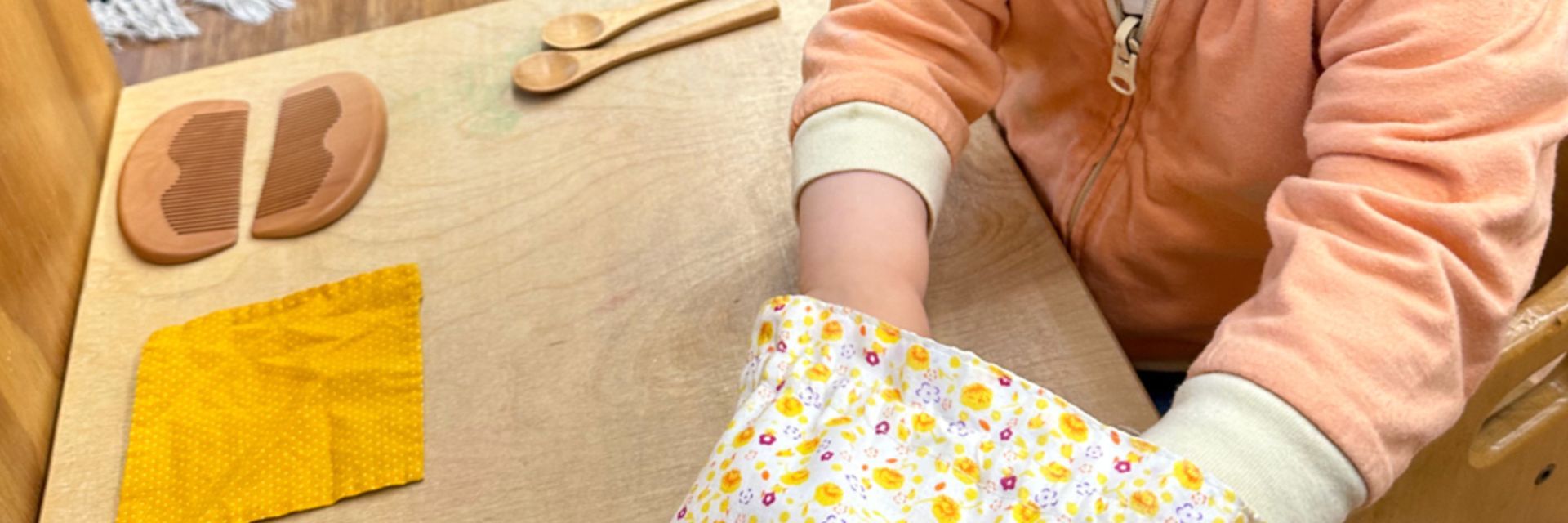
In our toddler and primary classrooms, we have special “mystery bags” or “stereognostic bags” to support the development of children’s stereognostic sense. These drawstring bags contain objects children have already encountered in their environment. We make sure children know the names of the objects, too.
The first bag we introduce has a set of four to six objects that belong to a classified group, such as kitchen utensils, art supplies, bathroom items, etc. These are real items that children have used in their lives.
The next bag has four to six general objects that are not grouped in any category (e.g. a comb, rock, sponge, funnel, cloth, etc.).
The third bag has three to four pairs of objects that are very different from each other.
The Experience
When we introduce each of these bags, we first show how to carry the bag and invite the child to take the bag to a table. We then carefully demonstrate how to open and close the bag and give the child a turn to try opening and closing. Next, we peek inside the bag and remove one item at a time, naming each object as we remove it from the bag and place it on the table. We also give the child a turn to feel each item. When all the objects are removed from the bag and lined up on the table, we name one and invite the child to place it in the bag. We repeat this until all the objects are back in the bag.
Then the fun begins! We explain that we are going to reach into the bag to find an item. Putting both hands into the bag (and without looking in the bag) we feel around and grasp an object. With some enthusiasm, we say the item’s name before we remove the item. Then we take the item out of the bag and show it to the child. Often the child watching takes great delight in the fact that we were able to name the object before seeing it. We repeat with the other items and then invite the child to try. When using the bag with the paired objects, the only difference is that we select one item, name it, remove it from the bag, and then try to feel for the matching item.
We regularly rotate the items in the bags so children have lots of opportunities to feel for what is in these “mystery bags”. Children find the experience to be absolutely delightful!
The best part is that when children try to recognize an object through touch alone, their brain receives the sensorial input and then forms a three-dimensional image that provides a more complete understanding and precise perception of the object.
“When the hand and arm are moved about an object, an impression of movement is added to that touch. Such an impression is attributed to a special, sixth sense, which is called a muscular sense, and which permits many impressions to be stored in a ‘muscular memory,’ which recalls movements that have been made.”
– Dr. Maria Montessori, The Discovery of the Child
The stereognostic bags are just one example of the many carefully designed materials we introduce in Montessori classrooms. We always love to have you come visit to see or experience these sensorial delights firsthand. Schedule a tour today!