
Nurturing the Mathematical Mind
Dr. Maria Montessori often referred to what she called the mathematical mind. She borrowed this term from the philosopher Blaise Pascal, who observed that the human mind is mathematical by nature. Montessori used it to describe the part of the mind that seeks exactitude. We can think of this as the ability to organize, classify, and quantify the world through logical and precise thinking.
Order is foundational to how our minds are built. Alongside order, imagination and abstraction work together to create mental constructs, such as the symbols and systems humans have agreed upon to represent quantities and relationships. These qualities are not gifts bestowed upon a few. They are universal human tendencies.
To think mathematically is natural to every human being. We are all born with the potential to reason, calculate, and find order in our environment. Yet, in traditional education, mathematics is often viewed as difficult or reserved for a select group of “math-minded” people. In Montessori education, we see this misconception as a matter of exposure, not ability.
Children frequently hear numbers spoken or see them printed in books and on signs, but these random experiences rarely connect to the real quantities or relationships that numbers represent. In this way, numbers remain abstract symbols that are memorized but not understood. Yet memory without understanding does not lead to intelligence.
The Montessori approach provides children with rich, sensorial experiences that ground mathematical concepts in reality. The meaningful, hands-on materials allow children to literally construct their understanding. In this way, children can move through a process of concrete experience to abstract computation and understanding.
How Montessori Math Is Organized
The math curriculum in our Children’s House classrooms is organized into six main groups of exercises:
- Numbers 1 to 10
- The Decimal System
- Continuation of Counting
- Exploration and Memorization of the Tables
- Passage to Abstraction
- Fractions
Each of these groups of exercises follows a natural progression that builds upon children’s growing understanding. Beautifully designed materials make abstract concepts concrete and meaningful.
Numbers 1 to 10
A common mistake in more traditional approaches is oversimplifying early math. Teaching numbers 1 to 10 might sound straightforward, but it actually involves integrating several distinct concepts: quantity, symbol, sequence, and one-to-one correspondence.
Montessori materials isolate each of these concepts so that children’s understanding can develop incrementally. After using the red rods to explore and understand the concept of length, children move on to number rods, which match the red rods except for one key aspect: the rods are color-coded in ten alternating blue and red sections to isolate the concept of quantity as a single, tangible entity.
To prepare the mind and the hand for writing, we introduced number symbols with the sandpaper numbers, which children use to trace and for memory games. Then, children begin matching number cards to the red and blue number rods to connect quantity to its symbol. Later, spindle boxes and the numbers and counters materials expand the idea of quantity into sets and introduce zero as an “empty set.”
Finally, playing the number memory game helps children apply their understanding to the real world. Even before formal arithmetic, children also begin to experience the operations of addition, subtraction, multiplication, and division through these materials.
The Decimal System
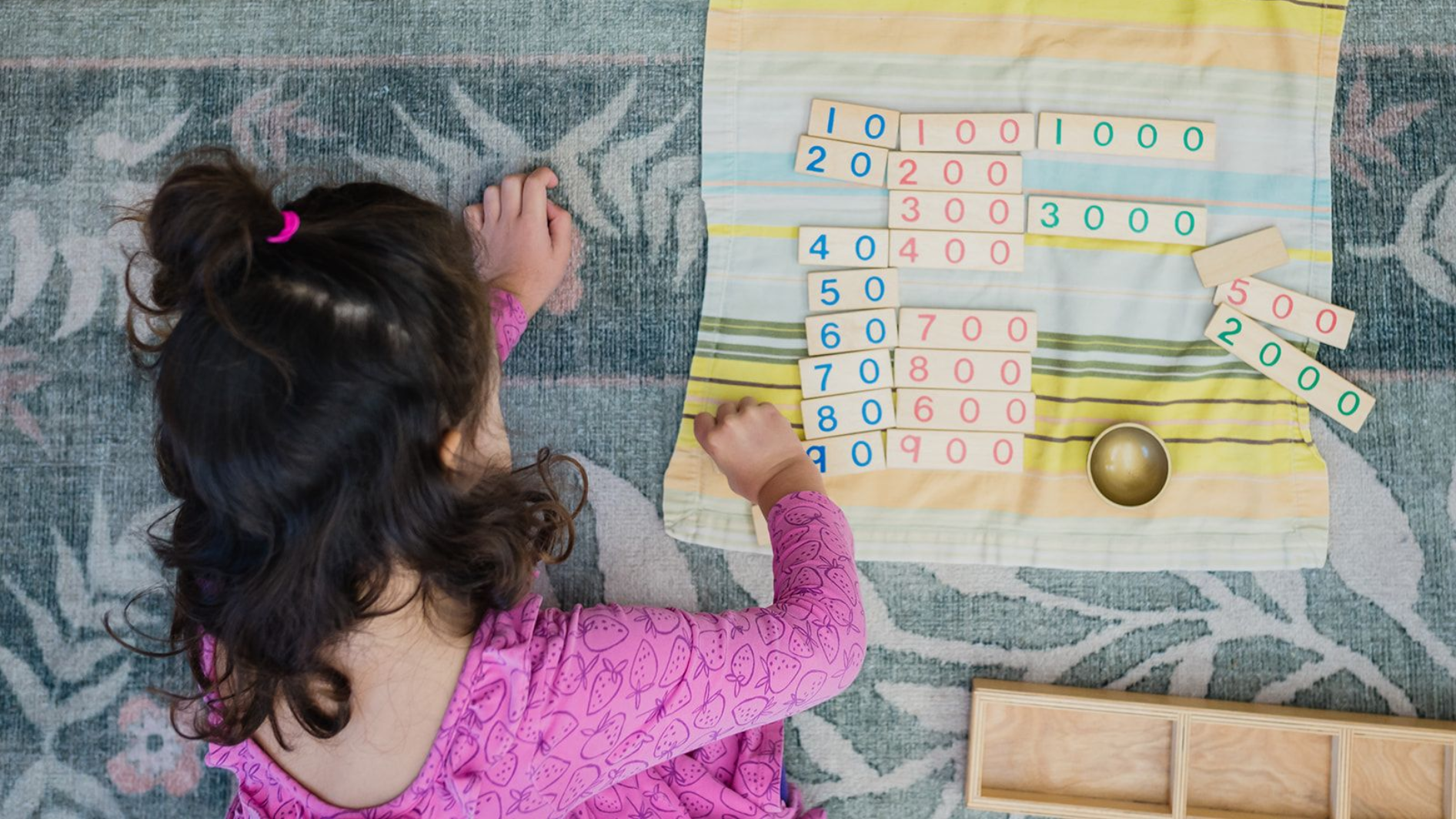
After mastering numbers 1 through 10, we introduce children to the decimal system. Through exploratory and game-like activities, children discover how quantities are organized hierarchically into units, tens, hundreds, and thousands. The golden bead material makes this concept tangible and deeply satisfying.
Children manipulate these materials to perform the four operations (addition, subtraction, multiplication, and division) concretely. The goal at this point is not accuracy in calculation, but understanding of process and hierarchy. We want children to grasp what happens during the different types of operations. For example, when we add, we combine smaller quantities to get a larger quantity. When we divide, we share or split something evenly. And so forth.
As children gain confidence, they transition to more abstract materials, such as the stamp game and dot game, which help them bridge the gap between hands-on and mental calculation.
Continuation of Counting
The Continuation of Counting exercises expand children’s understanding from 11 to 100 and eventually to 1,000. Using Seguin boards, the colored-bead stair, and bead chains, children practice linear and skip-counting and develop a visual and tactile sense of numerical progression.
This work reinforces the hierarchical structure of the decimal system while providing a sensorial experience of quantity. When children use the bead chains, for example, they see how 1,000 stretches far beyond 100.
We also have lots of counting opportunities within the classroom environments, so that abstract ideas are grounded in daily life. Through this repetition and exploration, children naturally progress from rote counting to true numerical understanding.
Exploration and Memorization of the Tables
After experiencing operations with quantity, children begin to explore and memorize essential math facts, such as the addition, subtraction, multiplication, and division tables.
The work begins concretely, using beads and boards, and progresses to more abstract exercises, such as blank charts, which allow children to test their memory independently.
Here, accuracy becomes the goal, supported by built-in controls of error. Through exploration, children often discover mathematical laws on their own. For instance, often realize that the order of factors doesn’t change the product in multiplication. These discoveries are especially meaningful because they are rooted in experience rather than rote learning.
Passage to Abstraction
At this stage, children begin to internalize mathematical concepts. They merge their understanding of process (from the decimal system) with their memorized math facts.
Materials such as the small bead frame, hierarchy material, and racks and tubes help children work with larger quantities and move naturally toward mental calculation. Here, children’s reasoning transitions from concrete to abstract, from experience to logic.
Fractions
We introduce fractions first as a sensorial exploration of parts of a whole. Later, the fraction materials become tools for mathematical reasoning. Children explore operations with fractions and concepts such as equivalence, preparing them for future work with more complex relationships.
The Beauty of Montessori Mathematics
Through carefully sequenced, hands-on experiences, Montessori mathematics allows each child to build genuine understanding, not just of numbers, but of relationships, order, and logic.
In this way, Montessori education honors the mathematical mind: the natural human drive toward precision, order, and understanding. When children have meaningful mathematical experiences, they also develop clear thinking and problem-solving in all areas of life.
To see more about how we nurture the mathematical mind,
schedule a tour here at our school in Lenox, MA.