
The First Six Years: Conquests of Independence
Meagan Ledendecker • June 5, 2023

As caregivers and parents, we have a bit of a bittersweet role. While we want to keep our children close, we ultimately need to support their path toward independence. 


We expect dependence at the beginning. Yet our newborns take their very first step toward independence at birth. Once born, they have to breathe on their own. And rather than get nutrition through the umbilical cord, they use effort to begin latching on or suckling. 


Throughout their first six years of life, our children achieve so many milestones of independence. Let’s take a look at some of these conquests of independence. You can use this framework as a guide and reminder of how we can support our children as they grow and develop. 


Birth to One Year


  • The first conquest of independence is birth which comes with the cutting of the umbilical cord. At this point, infants must breathe and gain nutrition on their own. Even our expression “It’s time to cut the cord” indicates the shift to increased independence.
  • Movement is another acquisition of independence in the first year as children begin to use their arms and legs, sit up and crawl, and move from one place to another. With this increased locomotion children no longer need to be held or carried.
  • Our children also begin to feed themselves. Even in the beginning when babies are nursing, we want them to indicate hunger. The weaning process and shift to using the weaning table supports this path to independence. As our children begin to eat and drink on their own, it is important to have foods and tools they can use independently (e.g. a shot glass for water, finger foods, etc.) rather than having an adult putting a utensil or bottle in their mouth. 
  • Children can also start to practice basic use of utensils. Having utensils that are child-sized and functional is key to independent use. 
  • In addition, our children need the opportunity to develop the ability to be by themselves. To become independent, they need to practice separating from their caregiver(s). Healthy separation depends upon healthy attachment, and our children need the chance to have some time without adult engagement.
  • Around the end of the first year, children begin to develop language to communicate their needs. Prior to this time, they are able to use other methods to communicate: crying, cooing, smiling, etc. This communication is the beginning of social skills and children’s ability to relate socially to others.


One to Three Years


  • During this time children can walk confidently and begin to run and climb. Once children can walk, they can begin the process of becoming independent in toileting. 
  • They become more independent with the use of their hands, which become tools for exploration. Because of this, children no longer need to rely on others to hold and carry items.
  • Language use allows children to begin to express themselves independently.
  • Children can start to become independent in dressing themselves. 
  • They begin to be able to use simple tools (crayons, sticks, cups, utensils, etc.).
  • They become more capable of caring for their own personal hygiene (brushing their teeth, washing their face, brushing their hair, etc.).
  • Children become more proficient with and capable of carrying their own items. 
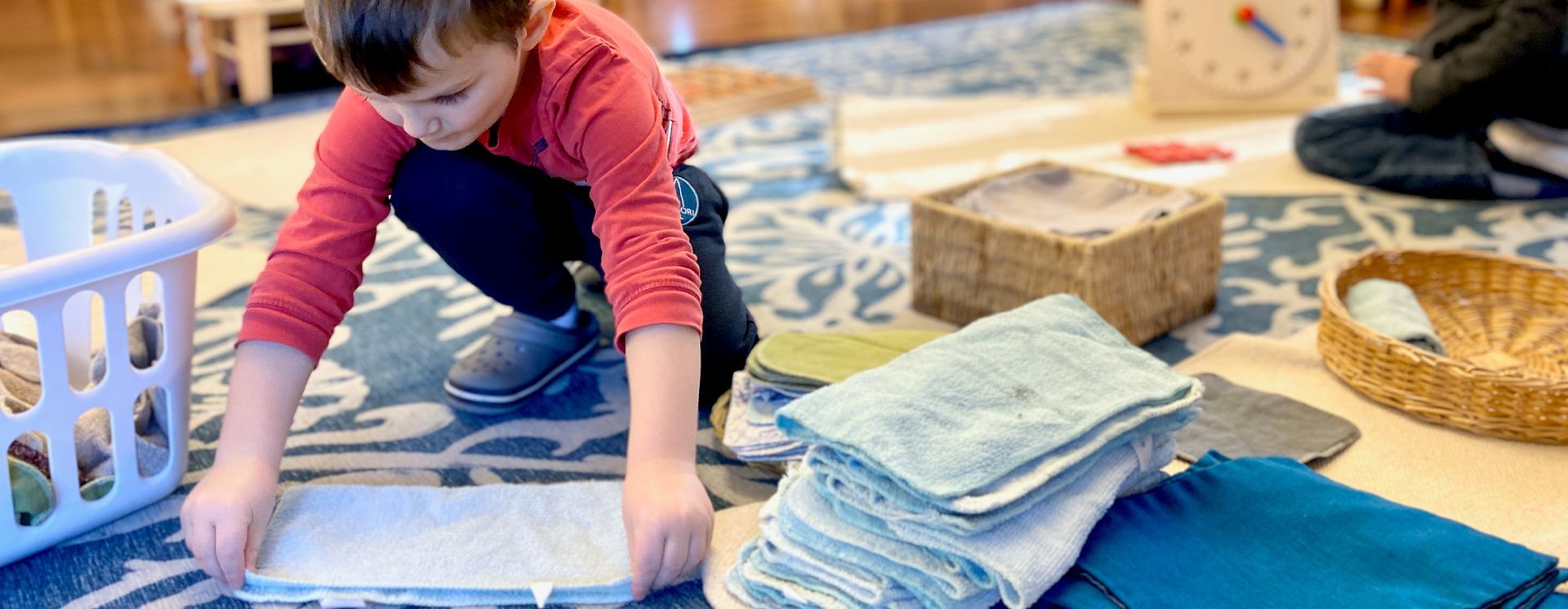
  • They have the capacity to clean up after themselves (putting away belongings, folding clothing, wiping spills, sweeping crumbs, etc.).


As children get older, they need opportunities to develop their will. Thus, during this stage of independence, it is really important that children can make choices. Making a choice means they are acting for themselves and exercising their will.


From Three to Four and a Half


  • If it hasn't happened already, children experience separation from the family (e.g. going to school). To be able to separate from one’s family is a new skill of independence. For children who haven’t been able to be by themselves, this is a harder process. During this time, children realize they can survive and trust others, which is a significant step in independence.
  • Children develop a wider range of social skills.
  • Children’s motor and visual skills become more developed and refined.
  • They are able to engage in more games (e.g. catching and throwing a ball).
  • They have finer manual dexterity (using individual fingers) as well as refined fine motor skills (when all fingers are working in unison).
  • Children begin to develop the ability to use language to express their emotions. They can learn a multitude of words to be able to express feelings. 
  • They can use utensils and tools to prepare their own food (which ideally happens prior to age three). Research shows that children involved in preparing their own food are more likely to try diverse foods.
  • Children learn to master fasteners (zippers, buckles, bows, etc.) and thus the self-care involved with dressing and undressing.
  • They can contribute to their community and care not only for themselves but also for the environment through simple responsibilities like setting the table, folding towels, etc.
  • They are more independent in caring for their own hygiene needs.
  • Because their vocabulary is expanding, children can use words to express emotions, as well as to better express their thoughts.


Four and a Half to Six


  • Children have more social independence and can not only do for themselves but can also use acquired skills to help others.
  • They become more independent in their social skills so they can internalize and apply the social norms of their community (e.g. pushing in chairs, greeting visitors, communicating that they need space, etc.).
  • Children become proficient in dressing themselves and can help younger peers with the dressing and undressing process (e.g. getting dressed for going outdoors).
  • They acquire the capacity to have empathy and compassion.
  • They have a basic understanding of quantities and how they are represented, instead of just mimicking or rote counting.
  • Children begin to recognize and use the symbols of our language (e.g. expressing themselves through writing or interpreting the thoughts of others through reading).


These conquests of independence are ultimately about becoming functionally independent. Young children are in a process of mastering different aspects of their lives and they need us, their caregivers, to support them in this process. 


Our children are so capable and they benefit when allowed to move toward increasing independence. If you’d like to see how our Montessori environments set children up for success, please schedule a tour!
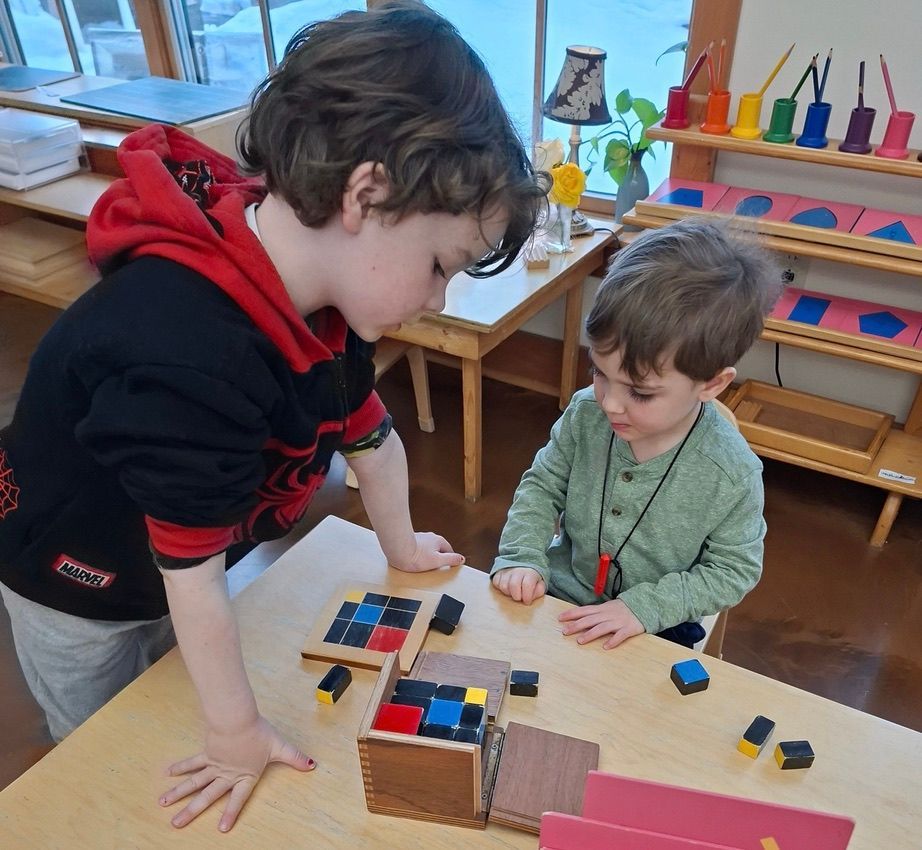
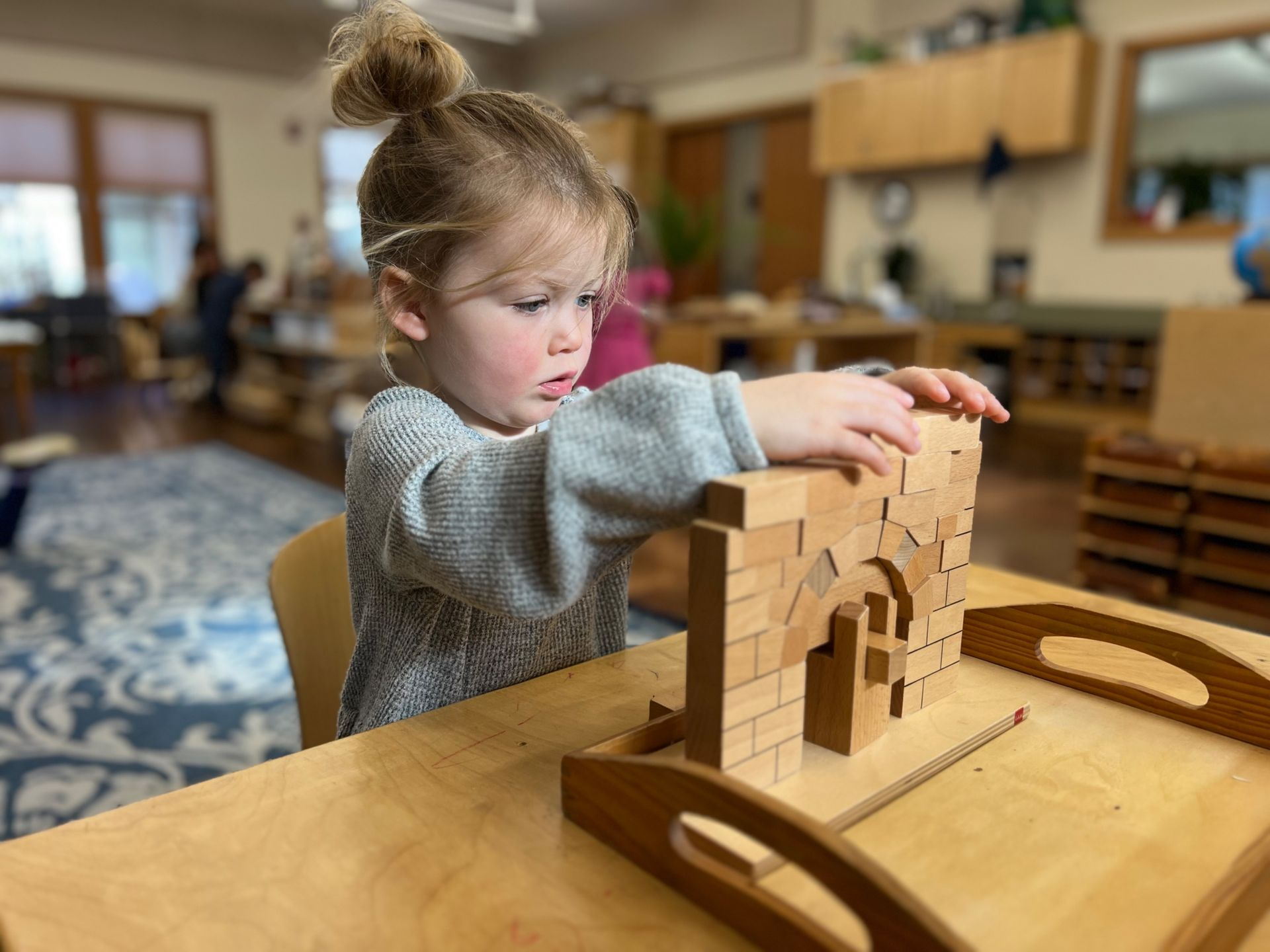
image of a preschool aged child on a carpet with the geometric prism lesson
By Meagan Ledendecker April 3, 2026
Explore the Montessori three-period lesson and how its quiet simplicity unites words and meaning during a child’s sensitive period for language.
By Meagan Ledendecker March 30, 2026
Rivers are so important to our human story. They are sources of nourishment, transportation, and connection. We see how children are naturally drawn to water, and rivers offer a powerful way to understand ecology, interdependence, and our place within the natural world. With this in mind, we want to share some of our favorite books about water, rivers, and watersheds. Through story and illustration, children can trace the journey of a single drop of water, observe how land and water shape one another, and begin to understand how human choices affect the health of our planet. We’ve grouped the following collection of river and water-focused books by developmental stage. Each title offers language, beauty, and meaningful context for deeper exploration. Whether you are reading with a toddler, a younger elementary child, or an emerging researcher, these books invite wonder, responsibility, and reverence for one of Earth’s most essential elements. For the Youngest
Image of an elementary child sitting on the floor with the Racks and Tubes math material
By Meagan Ledendecker March 23, 2026
In Montessori classrooms, long division unfolds very differently, giving children a real sense of why it works instead of the confusing sequence of steps to memorize and repeat that many of us remember. Learn more in this post.
Image of a toddler sitting at a table with arms raised in celebration while a smiling adult looks on
By Megan Ledendecker March 16, 2026
For children in the first three years of life, adults are not simply caregivers or teachers. We are models of movement, language, emotional regulation, and relationships. Learn more in this post.
Close up image of a child's hands holding a small green square card printed with the word
By Meagan Ledendecker March 9, 2026
In this blog post, learn more about how Montessori classrooms help children bring to consciousness language they already use every day by learning about how language functions and how meaning is carried when words stand in for each other.
Image of a toddler sleeping face down on a mat with a brightly colored blanket
By Meagan Ledendecker March 2, 2026
March 1 marks Baby Sleep Day, so we thought we’d take a moment to reflect on the alignment between Montessori philosophy and modern sleep science. In Montessori, we focus on independence as a path toward self-sufficiency. This is a gradual, mindful process of becoming capable. For our youngest children, this journey begins with mastery of the most fundamental human needs: eating, toileting, and sleeping. These areas matter deeply because they are ultimately under a child’s control. No one can make a child eat, use the toilet, or sleep. Our role, then, is not to force outcomes but to remove obstacles. As adults, we can provide thoughtful structure and support children as they develop the skills that build confidence and trust in their own bodies. Language Shapes Our Intentions In Montessori, our language reflects our values. For example, we don’t talk about “toilet training.” Instead, we focus on “toilet learning” because children are learning how to care for their bodies within the cultural norms. We are not training behavior. We are supporting development. The same is true for sleep. Rather than “sleep training,” Montessori invites us to think in terms of supporting independent sleep skills. We help children learn how to settle their bodies, self-soothe, and eventually fall asleep independently, all skills they will rely on for the rest of their lives. Why Sleep Matters So Much Research continues to affirm that sleep is foundational. Healthy sleep supports brain development and learning, emotional regulation, physical growth and immune function, and memory and attention. During sleep, children’s bodies perform essential functions, including muscle growth, tissue repair, protein synthesis, and the release of growth hormones. Deep sleep stages are when the most restorative processes occur. How Sleep Works  Two systems guide sleep: circadian rhythm and sleep pressure. Circadian rhythm is the body’s internal 24-hour clock, regulated by light and darkness. When it’s dark, the brain releases melatonin (the sleep hormone). When it’s light, melatonin decreases, and cortisol helps us wake. This is why darkness supports sleep, blue light from screens disrupts it, and consistent bedtimes matter. Newborns are not born with a mature circadian rhythm. It begins developing around six weeks and becomes more established around three months, which explains why early baby sleep can feel unpredictable. The other factor is sleep pressure. The longer we’re awake, the stronger the drive to sleep. This pressure builds during the day and resets after a long stretch of rest. When children miss their sleep window and become overtired, stress hormones (adrenaline and cortisol) kick in, creating that familiar “second wind.” Suddenly, a child who desperately needs sleep seems wired and alert. Understanding sleep pressure helps us time sleep before children tip into exhaustion. A Montessori Framework for Healthy Sleep To support both healthy attachment and independence, Montessori encourages clear, loving boundaries. Sleep is no different. We can focus on four key factors: a prepared sleep environment, predictable and respectful routines, healthy sleep associations, and limits with flexibility. A Prepared Sleep Environment Just as we prepare our Montessori classrooms, we want to be intentional about preparing our child’s sleep space at home. Key components include ensuring that the space is: Dark (blackout curtains help melatonin production) Quiet and calm Free of stimulating toys Slightly cool A good question to ask ourselves is: Would I easily fall asleep here? Predictable, Respectful Routines Children feel secure when they know what comes next. A simple home routine might include: The final feeding Putting on pajamas Toileting/diapering Tooth brushing A short story or song A hug and kiss goodnight Long baths or extended reading are best before the sleep window, not during it. Healthy Sleep Associations Children form associations with the conditions present when they fall asleep. If a child falls asleep being rocked, fed, or held, they will often need that same support during natural night wakings. Instead, we want to place a child in bed drowsy but awake, so they can practice falling asleep independently. Comfort objects, such as a small blanket or stuffed animal, can support this process. Limits with Flexibility Sleep needs change as children grow. Consistency matters, but we don’t want to be unnecessarily rigid. It’s important to keep in mind, though, that older children may test boundaries, delay routines, or negotiate endlessly. Calm, consistent follow-through reassures children that the structure is dependable. And just as importantly, adults need support, too! Holding limits is much harder when we are sleep-deprived, so self-care is essential. Why Independent Sleep Is an Act of Care Babies naturally cycle through light and deep sleep many times each night. When they wake briefly between cycles, a child who knows how to self-settle can drift back to sleep without distress. Independent sleep skills: Reduce frequent night wakings Support early morning sleep Improve mood and learning Protect parents’ well-being Plus, poor sleep in infancy is linked to challenges later in childhood, including difficulties with emotional regulation and health concerns. Supporting sleep early is preventative care. A Closing Thought for Baby Sleep Day Supporting sleep is not about forcing independence. It’s about preparing the conditions so independence can emerge naturally, with confidence and trust. If you’re navigating sleep challenges, please know this: you don’t have to do it alone. Sleep is learned, supported, and refined over time (just like every other human skill!). We want to honor sleep not as a struggle to overcome, but as a vital rhythm to protect, for both our children and ourselves. If you are interested in learning more, schedule a visit here in Lenox today!
Show More