An Expansive Experience: Music in Montessori
In Montessori, music is both interwoven into the curriculum and its own area of study. Like with the other subjects in Montessori, music begins sensorially, isolates difficulty through key lessons, and engages children in spontaneous forms of expression.
Sensorial & Connected Experiences
In our Toddler and Children’s House classrooms, we first offer sensorial experiences and impressions related to music. We encourage listening and awareness, perhaps hearing the snap of the snaps of the dressing frame or noticing the delicacy of the sound when placing a glass vase on a tray. The sound cylinders also help children distinguish fine gradations of softness and loudness. In the Silence Game, children become attuned to the many types of sounds around them when they sit quietly and listen.
Children are also able to link music and movement through the rhythm work in walking on the line activities, as well as simple activity rhymes, chants, and a wide repertoire of songs. In fact, we sing with the children every day because singing together is a powerful community builder!
We also offer children opportunities to listen to the music of various cultures. They love the challenge of identifying instruments by the sounds that they make, too.
Keys to Music
We use the bells in our primary programs, and the tone bars in our elementary classrooms, for music literacy (the reading, writing, and playing of music), as well as music theory, including notes, scales, chords, rhythm, melody, harmony, and form.
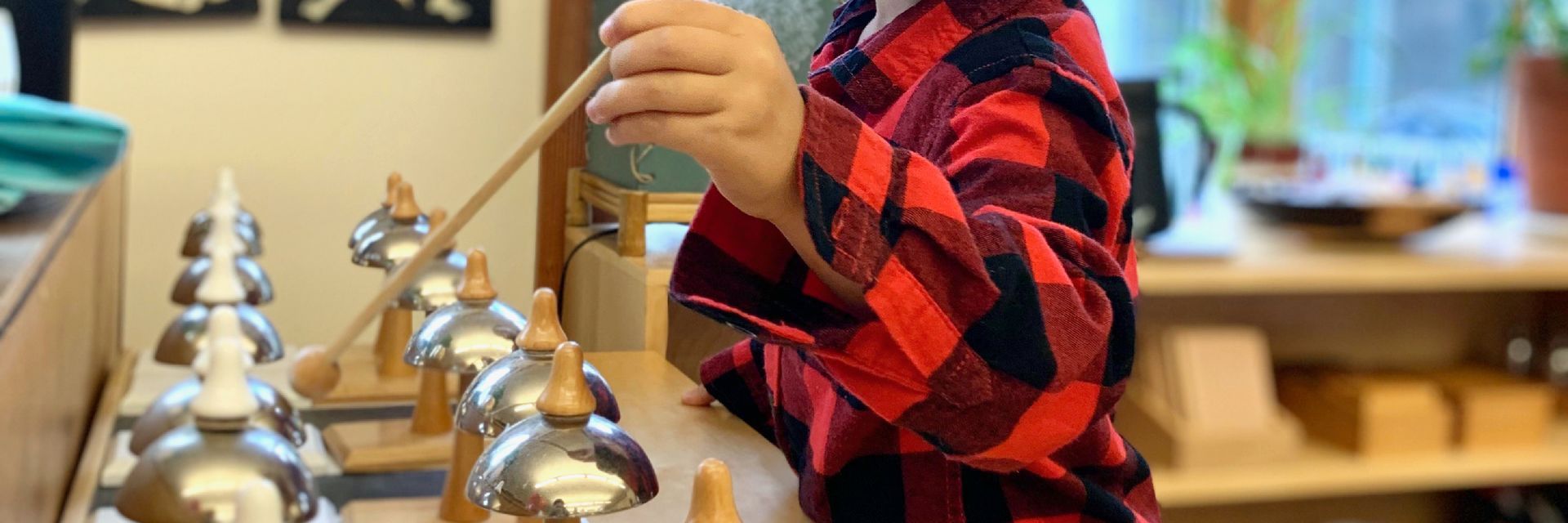
With the lovely Montessori bells, children begin to discriminate pitch by first playing individual bells, and then pairing and grading according to pitch. Next, they move on to naming the pitches and matching the pitches with their notes. Eventually, children learn the placement of the notes on the musical staff, as well as how scales and melodies can be written with notes on the staff.
In elementary classrooms, the work continues with the tone bars, as children learn about the degrees of the scale, intervals, the sequence of major scales with sharps and flats, key signatures, transposition, and the naming and notation of minor scales.
In Montessori, music is not a separate subject, only to be taught in a separate room by a specialist teacher. We want music to be an integral part of the daily life in the learning environment. As such, the Montessori music program provides keys to music that can be presented by any trained Montessori teacher regardless of musical background.
A Form of Language
Ultimately, music is a language of communication. Because music is a language, we think about music development as we do children’s language development and honor both the “spoken stage” and “written stage.”
Within the spoken stage, we may observe children picking away at bells or tone bars, striking notes without any apparent purpose. We treat this activity with respect as it represents the babbling stage of music.
The children eventually sing and play (on the Montessori’s bells and tone bar materials, as well as other instruments) and later they write and read music. Just like with the moveable alphabet for language, children can use a moveable alphabet for music notation to be able to write their own compositions. At this point, we often see children explode into music performance and notation, just as they explode into writing and reading.
While the bells and tone bars are used for many purposes, including work with music notation, they are first and foremost musical instruments and children love incorporating songs into classroom performances and sharing.
Expansive Program
In our primary and elementary communities, the music program is vast and includes music appreciation and history, singing, movement/dance, rhythm, pitch, intensity, timbre, form, style, listening, instrumental work, music theory, and the science behind the music.
By isolating difficulties and providing various preparation of skills, even our young children come to extemporaneous and spontaneous composition.
Music is part of culture and thus we want to ensure that our children have contact with the world of music. The future musicians among them will connect to their life’s path and their life’s work at an early age! Even those who don’t go on to study music develop an appreciation for and understanding of this important part of human culture.
We’d love for you to hear this harmony for yourself! Please reach out to schedule a tour!