
Montessori Materials Explained: The Metal Insets
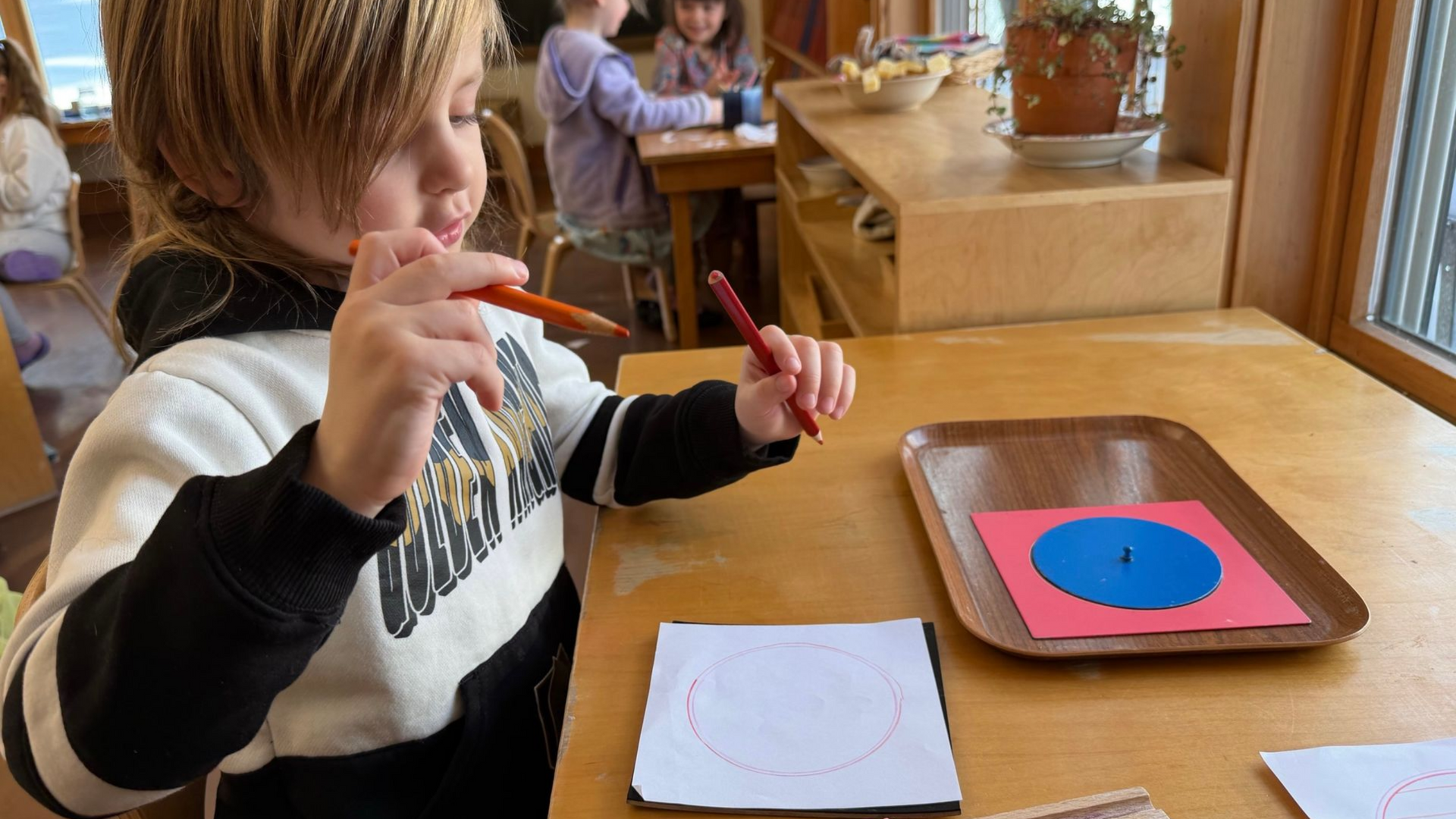
Among the many carefully designed materials in the Children’s House, the metal insets occupy a special place in the preparation for writing. Deceptively simple in appearance, they are in fact one of the most purposeful materials in the environment. Their purpose is to help children refine their hands for writing, and a great deal of preparation has already taken place before we invite children to use them.
What Are the Metal Insets?
The material consists of two stands, each holding five metal frames and their corresponding insets. The square frames are red, and the insets are blue, with a small knob at the center for holding. The ten shapes (square, triangle, circle, ellipse, rectangle, oval, trapezoid, pentagon, curvilinear triangle, and quatrefoil) are the same measurements as the geometric insets in wood that children have already encountered in the sensorial area. This deliberate connection is no accident: children are building on what their hands already know.
The metal insets have some accompanying materials: underlays that give a cushioned surface for pencil work, 14 x 14 cm sheets of paper (beginning with white, then gradually introducing color), and soft, colored pencils (each color kept in its own holder).
Why This Work Matters
The purposes of the metal insets are fourfold:
- mastery of the hand and the writing instrument (both in keeping within limits and in lightness of touch);
- refinement of the hand for writing;
- development of a sense of geometric design; and
- stimulation of the artistic sense.
These purposes weave together in each session of work, as children trace the frame, trace the inset, and fill in the resulting shape with careful, parallel lines.
The filling-in work is particularly significant. Children draw continuous, vertical lines from one edge of the shape to the other, turning at the inner outline and continuing in the opposite direction in a serpentine pattern. As their skill develops, they try to get the lines closer and closer together, with almost no white space between them. This is slow, deliberate work, and it is precisely that quality of attention that makes it such powerful preparation for writing. The movement comes from the shoulder, not the wrist, building the muscular coordination and control that will later flow into forming letters.
Progression of the Work
The metal insets offer a sequence of exercises that unfold over time. Children begin with a single frame and inset, using three colored pencils: one for tracing the frame, one for tracing the inset, and one for filling in. As their control deepens, subsequent exercises introduce the use of insets only (without frames), multiple overlapping shapes, repeated tracings of a single shape in different positions, and eventually fully free geometric design using any combination of insets, colors, and orientations.
One of the most beautiful exercises is graded color. Using a single inset and a single pencil, children fill the shape with vertical lines, moving from darker to lighter (or lighter to darker) by adjusting the pencil pressure. This exercise requires an extraordinary sensitivity of touch, and when children achieve it, the result is genuinely lovely.
This work can continue throughout a child’s entire time in the Children’s House. It can be relaxing and meditative, and when older children do it with great refinement, it naturally inspires younger children who observe them.
Readiness and Timing
Two key preparations precede the metal insets. Children should be able to trace the shapes of the geometry cabinet and the leaf shapes of the leaf cabinet using a stylus, and ideally they should be working with the movable alphabet. Timing matters. If we introduce the work too soon, before the hand is ready, it becomes too great a challenge rather than a satisfying one. The guide’s role is to observe carefully and to offer the presentation at the moment when it will be received with both readiness and joy.
The metal insets are a landmark in the child’s journey toward written language. This layered preparation honors both the intelligence of the hand and the unhurried nature of true readiness.
We invite you to come see the metal insets and the full breadth of our carefully prepared environment in person.
Contact us to schedule a visit here in Lenox MA to learn more about life in our Children’s House.