Montessori Materials Explained: The Roman Arch
A number of Montessori materials provide a bridge between sensorial exploration in the early years and more abstract understanding in elementary and beyond. Although the material remains the same, our children change and are able to revisit ideas with a new depth of understanding.
In the Children's House
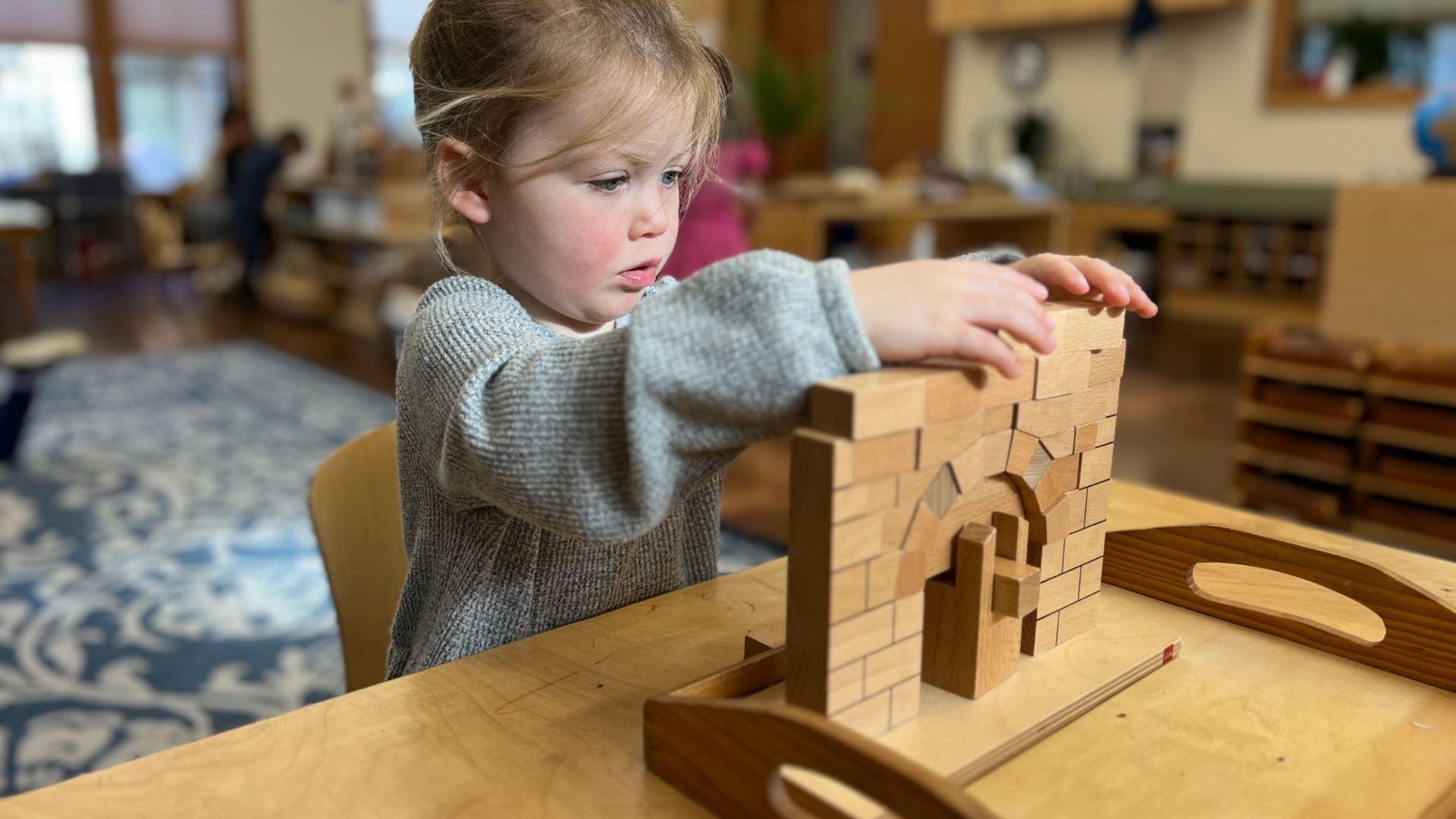
In the primary years, children bring the Roman Arch from the shelf to the table and approach the work from a simple desire to construct. The first step is sorting and children learn how to group all the pieces by shape and size. For a four-year-old, this alone is meaningful and a fabulous challenge, as the material contains an array of prisms (rectangular, trapezoidal, angled), all the same color yet subtly different. Finding the pattern of which pieces belong together is the first puzzle.
Then the building begins! Children place a semicircular support at the center of the base. Then they begin placing the trapezoidal pieces first, one on each side, working outward and upward in layers. Angled pieces fill the spaces beside them. Small rectangular prisms complete each course until the structure is level and ready for the final rectangular prisms, each layer offset from the one below so the seams never line up.
Children remove the support and discover that the arch stands on its own! There is nothing holding it together but the shape of each piece and the weight pressing down through them. For young children, this is the whole experience! They revel in the satisfaction of building a structure that holds itself up! This is a sensorial experience first and foremost: the feel of the pieces, the pattern of the build, the moment of release.
When children dismantle the arch, they make another discovery. They remove the side pieces first, leaving only the arch itself standing free. Then they take out one trapezoidal piece (think about the keystone of the arch) and everything falls.
Into the Elementary Years
When children encounter the Roman Arch again in their elementary years, they are ready for more. So we begin with a story, that goes something like this:
The Romans did not actually invent this arch. No one knows with certainty who did. The ancient Babylonians, Egyptians, and Greeks may all have known versions of it. The Etruscans — the civilization that existed on the Italian peninsula before Rome rose to prominence — used it as well. Some scholars credit Archimedes. What the Romans did was take an idea previously used only for small structures and develop it into something capable of spanning great distances and bearing extraordinary weight. Without mortar.
Then in the process of organizing the pieces, the children also learn how the pieces have names. The wedge-shaped stones are voussoirs, from the Latin volvere, to roll. The supports at the base are abutments or piers, from petra, meaning stone. And before we place the final piece, we pause so children can see the empty space waiting at the top of the arch. This last piece — the keystone — locks every other stone into place. The whole arch depends upon it.
Once built, children press lightly on the top of the completed arch and feel it hold. Engineers have found that the Roman Arch actually becomes stronger as more weight is placed upon it, because the downward force is redirected outward through the voussoirs into the piers on either side.
Where the Work Can Lead
For the elementary child, building the arch, learning its history, and naming its parts is just a beginning. From this single lesson, their questions tend to multiply. What did the Romans actually build with this arch? The aqueducts, long arcades of arches, some stacked in double and triple layers, that carried fresh water across the ancient world, are a fascinating next exploration. Many aqueducts still stand today. In Roman hands, the simple arch became a barrel vault, a groined vault, and eventually a dome. The history of engineering opens up alongside the history of Rome itself. So does the history of language. Elementary children who want to know the why behind things find the Latin roots of these terms quite interesting.
This is just one more example of Cosmic Education in practice. A hands-on experience connects engineering, history, language, and physics through children’s own curiosity.
Come visit us in Lenox, MA to see this material and other materials in action across classroom levels. We're always glad to show families what's happening at each stage of the journey.