Slow Down and Let Them Try: A Montessori Approach to Self-Care This Summer
Meagan Ledendecker • May 28, 2026
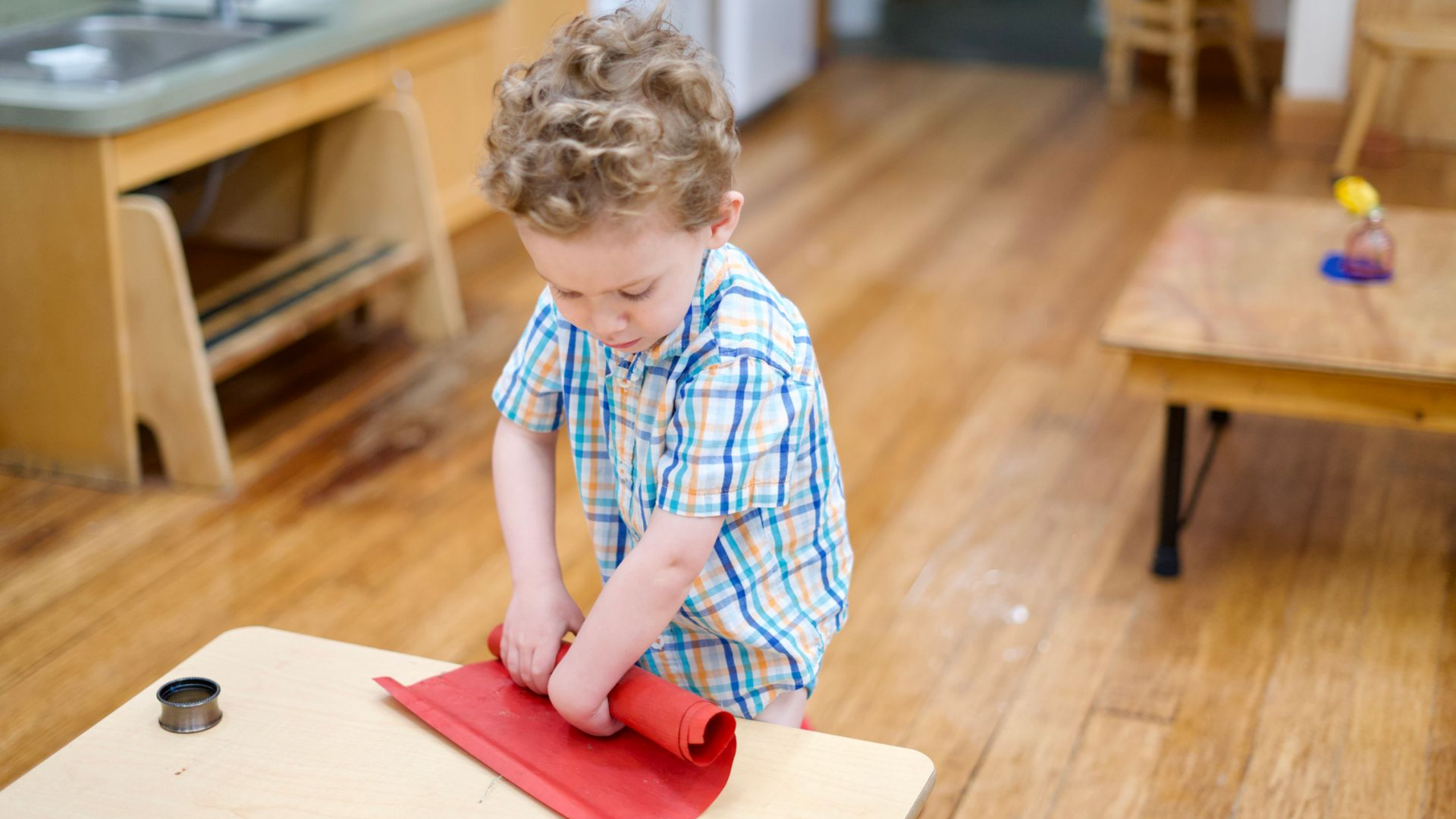
image of a preschool aged boy standing behind a low table rolling up a placemat

Summer has a rhythm that the school year rarely allows. Mornings without a clock ticking. Afternoons that stretch and meander. The unhurried pace of days that don't need to be anywhere quite so urgently. And tucked inside all of that spaciousness is one of the most valuable gifts the season can offer young children: time to do things for themselves.


In Montessori, we don’t rush through the practical life activities that help children care for their own bodies: washing hands, dressing, brushing hair and teeth, wiping a nose, and putting shoes away. We don’t even think of these as chores because they are among the most important developmental work in our children’s early years. And summer, with its slower tempo, is the perfect season to lean into them.


Independence Is the Destination and the Journey


Dr. Montessori understood that, from the very first moments of life, children are moving toward independence. The newborn who moves toward the breast has already taken a first step. That milestone transforms the toddler who learns to walk: their hands are suddenly free, they can move toward or away from people and objects in their world, and they can begin actively shaping their own experience rather than merely absorbing it.


Every act of self-care that children learn to do for themselves is another step along this path. Not because independence is about doing things alone, but because the child who can care for their own body develops a sense of genuine capability, a trust in themselves, and a growing understanding of who they are as unique human beings.


As the Montessori principle goes: Help me to do it myself.


Collaboration Before Independence


One of the most important things to understand about supporting self-care in young children is that the path to independence moves through a collaborative process. Often, things go awry when we swing between getting caught up in instruction, resorting to doing something for them, or stepping back entirely before they are ready.


The progression looks something like this: first, we do the activity with or for the child, using gentleness and narration, so the child is always a participant, even before they can act. "I'm going to put on your shirt. Let's put your arm through the sleeve." Gradually, the adult and child do the activity together. Eventually, the child begins to imitate, then to do it in their own way, imperfectly, slowly, and with deep satisfaction.


This progression is not a straight line. There will be days when a child who has been dressing independently for weeks suddenly wants help again. This is entirely normal and simply calls for a gentle return to collaboration: "Let's do this together." Our goal is always to offer just enough support and no more. We want to find the balance between honoring children's need for assistance and protecting their emerging sense of capability.


What Summer Makes Possible


The school year, for all its richness, is often defined by time pressure. Mornings, especially, can become a sequence of things that need to happen faster than children can manage them independently. Shoes get put on by adults. Jackets get zipped by adults. Hair gets brushed quickly and without much ceremony.


During the summer months, there is often more space to let a three-year-old button their own shirt, however long it takes. There is time to stand back and watch a toddler figure out how to pull on their own socks. There is room for the unhurried back-and-forth of teaching a child to wash their hands properly, step by step, at a sink they can actually reach.


If we think of these moments as children’s real work, we can avoid getting caught up in the sense that the process isn’t efficient! This is a long-term game. Our children are building their abilities and their internal sense of capability. 


Practical Suggestions for the Summer Months


Here are a few ideas for bringing the Montessori approach to self-care into your home this summer:


Set up the environment for success. Small adjustments allow children to manage their own needs without regularly needing adult assistance. Perhaps place a step stool at the bathroom sink. Provide low hooks for towels and clothing. Create a low shelf for children to store their belongings.


Choose clothing that supports independence. Elastic waistbands, velcro shoes, and loose-fitting shirts can be respectful of children's current physical abilities. Children who can dress themselves feel capable.


Narrate without taking over. When a child is struggling with a button or a zipper, resist the impulse to fix it immediately. Try instead: "You're working hard on that. Would you like to try once more, or would you like some help?" This keeps the child in the driver's seat of their own experience.


Begin with larger movements, then refine. Just as with any practical life work, self-care builds from the general to the specific. Children learn to pull a shirt over their head before they learn to fasten buttons. They learn to remove their shoes before they learn to tie them. Follow your child's current capacity and build from there.


Move without talking; talk without moving. This Montessori principle helps us demonstrate a self-care activity most effectively. When showing a child how to wash their hands, do it slowly and silently, so the movement is fully visible. Then, separately, use words to name the steps. Children often find it difficult to simultaneously track our narration and demonstration. 


Self-Care Activities Worth Practicing This Summer


Consider the range of self-care activities appropriate for our children. Do they include undressing and dressing, hand washing, brushing hair, brushing teeth, wiping the nose, and caring for shoes? What else would your child benefit from learning how to master? Your child can practice these skills gradually as part of the natural rhythm of daily life.


There is no hurry. There is no single right timeline. What matters is the collaborative attitude that underlies each interaction. The adult and child are working together. We honor children's participation. Our goal is always to help children come to know what they are capable of.


The Deeper Meaning


Dr. Montessori was clear that the destination of this entire developmental arc, across all four planes of development, all the way to young adulthood, is a person who can provide for themselves, take responsibility for their own actions, plan for their own future, and perhaps even support others on their own path toward independence. It begins here with a small person pulling on their own socks or learning to wash their own hands, and in a summer that is long enough and slow enough to let them try.


We hope your summer is full of these quiet, meaningful moments. If you would like to learn more about honoring children’s journey toward independence, please schedule a visit here in Lenox, MA.
Preschool aged child sitting on the floor with a puzzle map of Australia
By Meagan Ledendecker May 28, 2026
Montessori geography materials help children explore the world through hands-on learning, imagination, and real-world discovery.
Two preschool aged children sitting at the top of a slide, smiling and holding hands
By Meagan Ledendecker May 28, 2026
Discover how Montessori nurtures intrinsic motivation by replacing rewards and punishment with curiosity, confidence, and self-discipline.
Image of an elementary girl standing with a trowel behind a raised garden bed
By Meagan Ledendecker May 28, 2026
Explore Montessori biology this summer through hands-on discovery, nature observation, and meaningful curiosity about plants and animals.
Image of a preschool aged girl sitting at a small table with a palette of water colors and paper
By Meagan Ledendecker May 28, 2026
Discover how Montessori-inspired art activities nurture creativity, confidence, and self-expression through process-focused exploration.
Image of a preschool aged girl standing in front of an ironing board with a spray bottle and fabric
By Meagan Ledendecker May 25, 2026
When children struggle, Montessori asks: what's in the way? Explore how the prepared environment helps children find their way back to themselves.
By Meagan Ledendecker May 18, 2026
If you've spent any time in a Montessori early childhood classroom, you've likely noticed the sandpaper letters on the shelf: elegant, tactile, traced by small fingers again and again. And if you've looked closely, you may have noticed something that surprises many families. Those letters are in cursive. In a world where most children learn to print first, Montessori's cursive-first approach raises questions. Why cursive? Why so early? The answers reach back to Dr. Maria Montessori's own careful observations of children, as well as forward to what modern neuroscience is now confirming about the developing brain. What Dr. Montessori Actually Observed Dr. Montessori was a meticulous observer of children, and her thinking about writing developed through years of direct experimentation. One of her core observations was that children naturally gravitate toward curved, flowing lines rather than the rigid, straight strokes that were (and often still are) the starting point for teaching print. She noticed this pattern across multiple contexts. When children who were learning to write began with rows of straight strokes, their attention would gradually drift, and the straight lines would slowly transform into curves, as if the child's hand were following its own natural inclination. And when children drew spontaneously by tracing figures in sand with a fallen twig, or scribbling freely on paper, they rarely produced short, straight lines. Instead, they made long, flowing, interlaced curves. Dr. Montessori paid attention. Rather than something random, she recognized the hand's natural motion expressing itself. Critical of standard teaching approaches that began with isolated geometric strokes, or regimented mark-making, Dr. Montessori saw that cursive script, with its connected, flowing letters, aligned far more naturally with the motions children were already making. It worked with the child's hand, rather than against it. The Neurological Case for Cursive Thanks to her keen observations, Dr. Montessori intuited benefits that research is now beginning to confirm. Modern brain science provides a compelling case for the value of cursive writing. This is especially powerful in early childhood, when the brain is forming the connections that will support reading, fine motor coordination, and cognitive development for years to come. Dr. William R. Klemm, writing in Psychology Today, summarized findings showing that learning cursive trains the brain to develop what researchers call “functional specialization,” or the capacity for optimal efficiency. Brain imaging studies show how multiple areas of the brain are activated simultaneously during cursive writing in a way that doesn't happen with typing or print. The integration of sensation, movement control, and thinking that cursive requires appears to support broader cognitive development in genuinely significant ways. Klemm also suggested that learning cursive trains the brain for more effective visual scanning, with potential benefits for reading speed and hand-eye coordination. In other words, the child who traces cursive sandpaper letters with their fingertips is developing neural pathways that support a wide range of future learning. Clarity, Beauty, and the Practical Benefits Beyond the neurological research, there are practical reasons that Montessori educators have observed over generations of practice. Cursive provides a better visual distinction between letters that are easily confused in print. Think about the pairs that trip up so many young learners: b and d, p and q. In cursive, these letters look different from one another, which reduces the visual confusion that causes so many children to struggle in the early stages of reading and writing. And then there is the matter of beauty, something Dr. Montessori took seriously in everything she prepared for children. She wrote that, in teaching writing, we should pay close attention to "the beauty of form" and "the flowing quality of the letters." Cursive handwriting, when developed well, is genuinely lovely. It is a form of penmanship that connects children to a long tradition of human expression through the written word. The Montessori approach treats handwriting as a craft worth caring about. What This Looks Like in the Classroom In a Montessori early childhood environment, the path to writing begins long before a child picks up a pencil. Practical life activities like pouring, spooning, buttoning, and lacing quietly help children develop the fine motor control and hand-eye coordination that writing requires. The sensorial materials train children’s pincer grip and refine the precision of small muscle movements. And the metal insets give children practice with the flowing, curved lines that build cursive letters. Then children begin using the sandpaper letters. While verbalizing the phonetic sound, children trace the letter with two fingers. Children feel the letter, produce its sound, and see its form. This multi-sensory experience engages multiple brain areas simultaneously and creates rich, layered associations that support both writing and reading development. By the time children are ready to write independently, they have been preparing their hand and mind for months, often without even realizing it. A Method Ahead of Its Time Dr. Montessori consistently arrived at insights that research has later confirmed. Her reasons for emphasizing cursive were rooted in direct observation of children. She watched children’s hands and their natural movements. She also looked to see what helped them and what created unnecessary struggle. Dr. Montessori wasn't following a trend or a theory. She was following the child. Decades later, brain imaging technology and developmental research are catching up to what Dr. Montessori saw. Flowing lines of cursive script, the sandpaper letters on the shelf, the careful preparation of the hand before children ever pick up the pencil. This is a deep and practical understanding of how children's minds and bodies actually work. For families curious about why Montessori makes this choice, the short answer is this: because children's hands already know how to make these movements. Montessori simply listens to what the hand is already telling us and builds from there. Visit our school in Lenox, MA and see the sandpaper letters and writing materials in action. We'd love to show you how the path to writing unfolds in Montessori.
Show More