The Globe That Opens the World: How Montessori Geography Ignites Imagination
Meagan Ledendecker • May 28, 2026
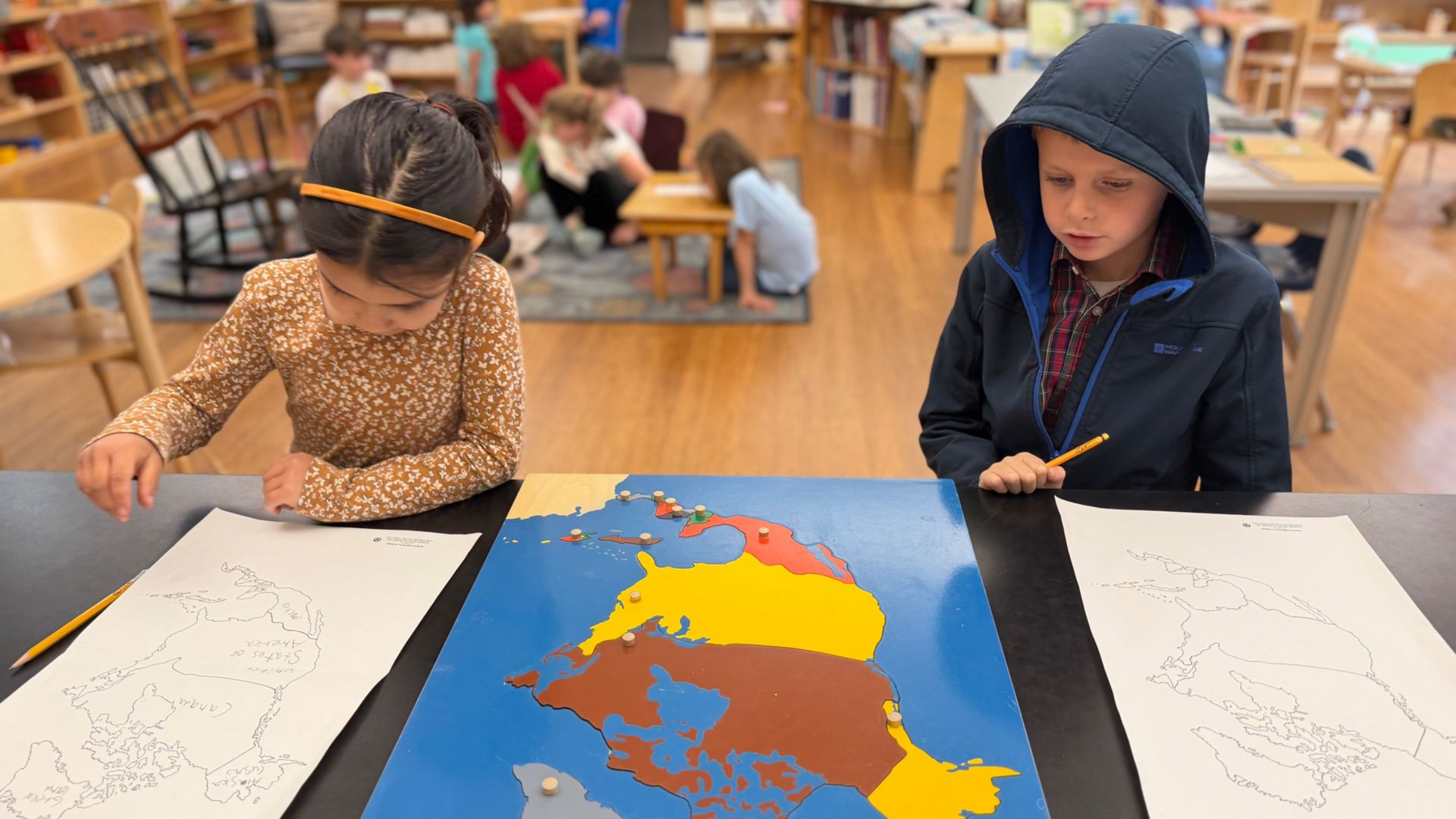
Image of two elementary children sitting at a table with a puzzle map of North America between them, and drawing paper to copy it

In seeking to understand the world, young children ask so many questions! The Montessori geography materials meet that curiosity with simple, beautiful objects that help children put the world into context.


As Dr. Montessori explains in Education for a New World, "Children are not able to follow long explanations, and need simple answers, where possible helped by some illustrative object, such as the globe to the child's quest in geography."


So our geography materials offer illustrative objects, such as a globe, puzzle maps, and trays of land and water forms. The results of offering children these real objects are often quietly extraordinary.


Real Things to Imagine


Dr. Montessori observed that young children have a remarkable and largely untapped capacity for imagination, but this capacity is often channeled in a limited way. As she wrote, "This strength of imagination in the child under six is usually expended on toys and fairy tales, but surely we can give him real things to imagine about, so putting him in more accurate relation with his environment." 


Certainly, the study of geography provides the young child with tremendous opportunities to mentally explore seemingly new worlds: places full of different animals, homes, people, and landscapes unlike anything in their immediate experience.


Dr. Montessori shared a charming story that captures the Montessori approach to geography. A group of six-year-olds was gathered around a globe when a child not yet four years old ran up to see. Looking at the model of the earth, the little one suddenly understood something: "Is this the world? Now I understand how it is my uncle has gone three times round the world.” In that moment, the child could understand that the globe was only a model and that the real world was immense. In a single interaction with one simple material, a young child had made a conceptual leap from the concrete object in front of them to the vast reality it represented.


A Mind That Goes Beyond the Concrete


Young children are often underestimated in their capacity for abstract thought. Because they learn through their senses and their hands, we sometimes assume they can only grasp what is directly in front of them. Dr. Montessori pushed back on this firmly: "Is the child's mental horizon limited to what he sees? No. He has a type of mind that goes beyond the concrete. He has the great power of imagination."


The child who can imagine a fairy and a fairyland, as Dr. Montessori noted, has no difficulty imagining South America, or a distant mountain range, or a culture on the other side of the earth. What they need is something real and beautiful to anchor that imagination. The geography materials allow children to imagine aspects of the Earth and its features that they might not otherwise see or access. They can experience the land and water forms and learn the vocabulary of strait, isthmus, and peninsula. They can differentiate between the continents and begin to explore the rich differences of human cultures.


Learning Through the Hands


Like all Montessori materials, the geography materials for children ages three to six are designed to be touched, handled, and explored. As Dr. Montessori explains, "the child's mind can acquire culture at a much earlier age than is generally supposed, but his way of taking in knowledge is by certain kinds of activity which involve movement."


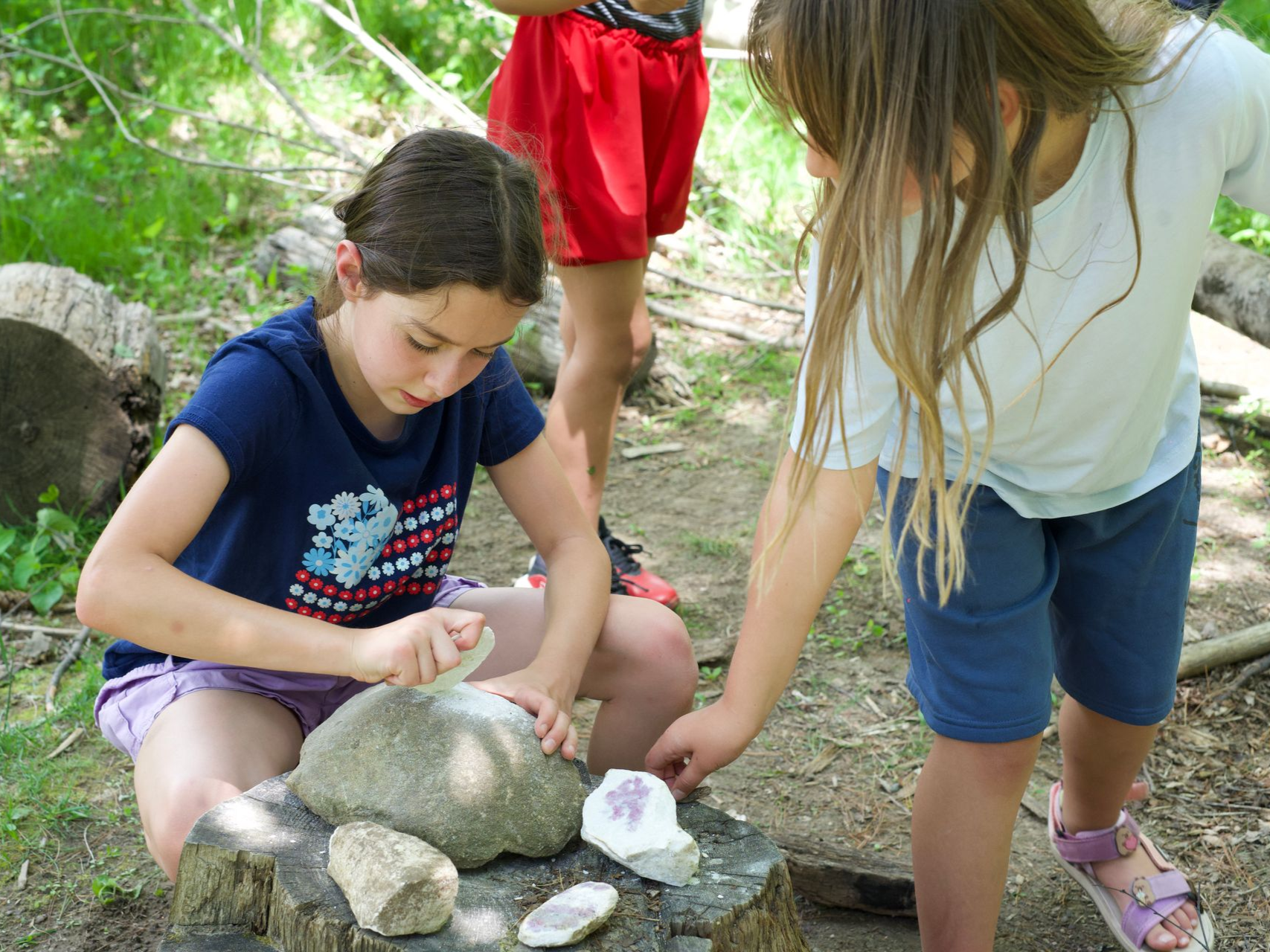
The land-and-water globe invites children to run their fingers across rough land and smooth water, building a sensory impression of the earth's surface that extends beyond a two-dimensional photo. The land and water forms allow children to pour water into trays with pre-shaped landforms, so they can experientially discover the physical differences between a peninsula and an isthmus, a cape and a bay. The puzzle maps offer children a satisfying, hands-on experience of lifting, rotating, and placing wooden continent pieces, and even distinguishing between countries and states. Children touch the shapes of the continents with their fingertips and name them as their own. 


Through all of this, children are doing what Dr. Montessori consistently described as their natural mode of learning: using their hands to access new information, and then using that grounding in reality to conceptualize aspects of the world through the power of imagination.


Curiosity as a Compass


One of the more significant outcomes of Montessori geography work is how it awakens and deepens children’s curiosity. As Dr. Montessori wrote, "When a child's interest is aroused on the basis of reality, the desire to know more on the subject is born at the same time." The early childhood geography materials are designed to open a door so as to make the world feel knowable, fascinating, and worth exploring.

The continent boxes, the cultural photographs, the land and water forms — all of it plants seeds that will bloom into the rich, research-driven, globally aware work of the Montessori elementary curriculum, where children explore the history of civilizations, the geography of ecosystems, and the deep interconnection of all life on earth.


What Families Can Do at Home


The spirit of Montessori geography extends naturally into family life. A globe at home, pulled out whenever mentioning a faraway place in conversation, does far more than a map on the wall. Photographs from different countries, looked at together with a child and accompanied by genuine curiosity and conversation, open the same doors as the continent packets in the classroom. When something happens in another part of the world, and a child is nearby, finding it on the globe together — even for a moment — plants a seed of geographical awareness.


The principle behind all of it is one Dr. Montessori returned to throughout her work: give children real things to wonder about. Trust their minds. Point them toward the vast, varied world. It’s worth exploring endlessly!


We'd love for you to visit our classroom and see the geography materials in action. Schedule a tour here in Lenox, MA and watch what happens when a child first encounters the globe.
Two preschool aged children sitting at the top of a slide, smiling and holding hands
By Meagan Ledendecker May 28, 2026
Discover how Montessori nurtures intrinsic motivation by replacing rewards and punishment with curiosity, confidence, and self-discipline.
Image of an elementary girl standing with a trowel behind a raised garden bed
By Meagan Ledendecker May 28, 2026
Explore Montessori biology this summer through hands-on discovery, nature observation, and meaningful curiosity about plants and animals.
image of a preschool aged boy standing behind a low table rolling up a placemat
By Meagan Ledendecker May 28, 2026
Discover how Montessori self-care activities build independence, confidence, and capability through everyday summer routines.
Image of a preschool aged girl sitting at a small table with a palette of water colors and paper
By Meagan Ledendecker May 28, 2026
Discover how Montessori-inspired art activities nurture creativity, confidence, and self-expression through process-focused exploration.
Image of a preschool aged girl standing in front of an ironing board with a spray bottle and fabric
By Meagan Ledendecker May 25, 2026
When children struggle, Montessori asks: what's in the way? Explore how the prepared environment helps children find their way back to themselves.
By Meagan Ledendecker May 18, 2026
If you've spent any time in a Montessori early childhood classroom, you've likely noticed the sandpaper letters on the shelf: elegant, tactile, traced by small fingers again and again. And if you've looked closely, you may have noticed something that surprises many families. Those letters are in cursive. In a world where most children learn to print first, Montessori's cursive-first approach raises questions. Why cursive? Why so early? The answers reach back to Dr. Maria Montessori's own careful observations of children, as well as forward to what modern neuroscience is now confirming about the developing brain. What Dr. Montessori Actually Observed Dr. Montessori was a meticulous observer of children, and her thinking about writing developed through years of direct experimentation. One of her core observations was that children naturally gravitate toward curved, flowing lines rather than the rigid, straight strokes that were (and often still are) the starting point for teaching print. She noticed this pattern across multiple contexts. When children who were learning to write began with rows of straight strokes, their attention would gradually drift, and the straight lines would slowly transform into curves, as if the child's hand were following its own natural inclination. And when children drew spontaneously by tracing figures in sand with a fallen twig, or scribbling freely on paper, they rarely produced short, straight lines. Instead, they made long, flowing, interlaced curves. Dr. Montessori paid attention. Rather than something random, she recognized the hand's natural motion expressing itself. Critical of standard teaching approaches that began with isolated geometric strokes, or regimented mark-making, Dr. Montessori saw that cursive script, with its connected, flowing letters, aligned far more naturally with the motions children were already making. It worked with the child's hand, rather than against it. The Neurological Case for Cursive Thanks to her keen observations, Dr. Montessori intuited benefits that research is now beginning to confirm. Modern brain science provides a compelling case for the value of cursive writing. This is especially powerful in early childhood, when the brain is forming the connections that will support reading, fine motor coordination, and cognitive development for years to come. Dr. William R. Klemm, writing in Psychology Today, summarized findings showing that learning cursive trains the brain to develop what researchers call “functional specialization,” or the capacity for optimal efficiency. Brain imaging studies show how multiple areas of the brain are activated simultaneously during cursive writing in a way that doesn't happen with typing or print. The integration of sensation, movement control, and thinking that cursive requires appears to support broader cognitive development in genuinely significant ways. Klemm also suggested that learning cursive trains the brain for more effective visual scanning, with potential benefits for reading speed and hand-eye coordination. In other words, the child who traces cursive sandpaper letters with their fingertips is developing neural pathways that support a wide range of future learning. Clarity, Beauty, and the Practical Benefits Beyond the neurological research, there are practical reasons that Montessori educators have observed over generations of practice. Cursive provides a better visual distinction between letters that are easily confused in print. Think about the pairs that trip up so many young learners: b and d, p and q. In cursive, these letters look different from one another, which reduces the visual confusion that causes so many children to struggle in the early stages of reading and writing. And then there is the matter of beauty, something Dr. Montessori took seriously in everything she prepared for children. She wrote that, in teaching writing, we should pay close attention to "the beauty of form" and "the flowing quality of the letters." Cursive handwriting, when developed well, is genuinely lovely. It is a form of penmanship that connects children to a long tradition of human expression through the written word. The Montessori approach treats handwriting as a craft worth caring about. What This Looks Like in the Classroom In a Montessori early childhood environment, the path to writing begins long before a child picks up a pencil. Practical life activities like pouring, spooning, buttoning, and lacing quietly help children develop the fine motor control and hand-eye coordination that writing requires. The sensorial materials train children’s pincer grip and refine the precision of small muscle movements. And the metal insets give children practice with the flowing, curved lines that build cursive letters. Then children begin using the sandpaper letters. While verbalizing the phonetic sound, children trace the letter with two fingers. Children feel the letter, produce its sound, and see its form. This multi-sensory experience engages multiple brain areas simultaneously and creates rich, layered associations that support both writing and reading development. By the time children are ready to write independently, they have been preparing their hand and mind for months, often without even realizing it. A Method Ahead of Its Time Dr. Montessori consistently arrived at insights that research has later confirmed. Her reasons for emphasizing cursive were rooted in direct observation of children. She watched children’s hands and their natural movements. She also looked to see what helped them and what created unnecessary struggle. Dr. Montessori wasn't following a trend or a theory. She was following the child. Decades later, brain imaging technology and developmental research are catching up to what Dr. Montessori saw. Flowing lines of cursive script, the sandpaper letters on the shelf, the careful preparation of the hand before children ever pick up the pencil. This is a deep and practical understanding of how children's minds and bodies actually work. For families curious about why Montessori makes this choice, the short answer is this: because children's hands already know how to make these movements. Montessori simply listens to what the hand is already telling us and builds from there. Visit our school in Lenox, MA and see the sandpaper letters and writing materials in action. We'd love to show you how the path to writing unfolds in Montessori.
Show More