Materials Spotlight: Animal Story Cards
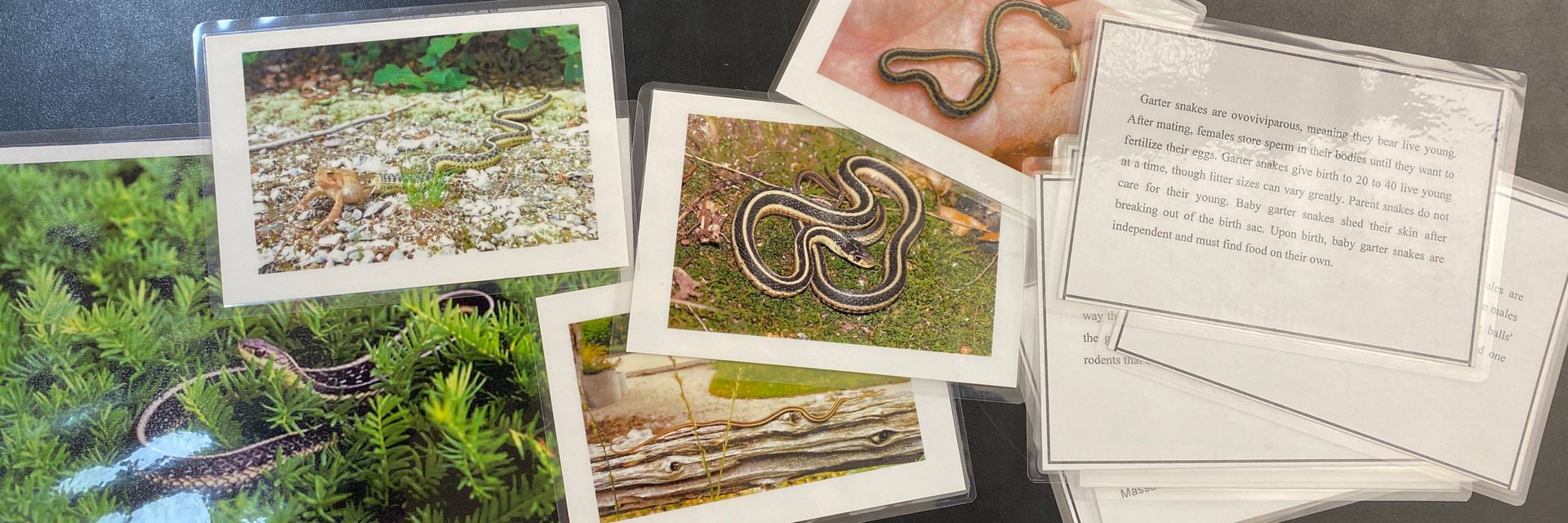
Children adore animals! Our elementary students (and even some older primary students) often love to start researching animals. To capitalize upon this interest and use it to build the base for more in-depth research skills, we have a set of materials called the Animal Story Cards. These picture and story cards introduce animals that live in the region. They are comprised of a few folders with pictures and text that get rotated throughout the year.
The collection of cards includes a large picture of the animal in its natural environment, a large text card with general information about the animal, and then a series of smaller images and matching text cards that show and detail information about the animal’s habitat, how it protects itself, its natural diet, how it reproduces, and how it cares for its young.
This material helps children begin to classify and organize their zoological awareness of native animals. We also try to gear the stories to the needs of the animals with which the children may have had first-hand experience so that the activity reinforces their prior knowledge.
Information in the folders draws children’s attention to certain aspects of animals’ lives and the interconnections of animals through various food chains or predator/prey relationships. Each folder focuses on one animal and contains picture cards and text material relevant to that animal’s basic needs.
As we rotate the cards throughout the year to provide exposure to various animals, we also ensure the selected animals have contrasting qualities (e.g., a mammal, a bird, an amphibian, etc.).
In addition to providing a base for future research skills, this material also increases children's awareness and knowledge of animals that live in the surrounding environment, highlights differences among animals, cultivates an appreciation for animals, and provides an interesting reading activity.
When we present this material, we gather a small group of children and place the large picture card in the center of the rug or table. Often, we start with a little story about the animal, and as we tell the story, we introduce the related smaller picture cards as they become relevant.
We only have three or four of these animal stories in the classroom so that the children can use this material as a model for their own research and work. Ultimately, we want children to turn to books in the classroom or the library for further information. Those in the early stages of reading and research often enjoy drawing the animal and a picture of what it eats, how it cares for its young, etc.
So the youngest children can access the text and practice their reading, we sometimes have one-word labels that can work in place of the text cards. Early readers can access the easier text and place the one-word labels underneath the matching pictures.
We encourage children to share the story of the animal we introduced to others in the class, explore the other folders, and try to match the pictures and the different text cards. Sometimes, children get excited about making an animal story set of their own. This activity can result in a great deal of concentrated work!
As children use the Animal Story Cards, they begin to also realize that animals have fundamental needs just like humans do!
We’d love for you to visit the school to see this and the many other ways we cultivate an appreciation for the natural world.
Schedule a tour today!