
Participation in Practical Matters

In our daily lives, we do so much to take maintain our surroundings, as well as care for ourselves and others. As adults, we take these activities for granted. Young children, however, yearn to participate in practical matters.
Everything we do to care for the environment, ourselves, and others make up what can be called "practical life" activities. In a Montessori home or school environment, practical life activities help children learn about cultural norms, while also helping them develop internal motivation, intellect, and body coordination.
Purposes of Practical Life
With this in mind, we can really think about how practical life activities have two purposes: one is external and one is internal. The first purpose is to help children engage in something meaningful and real. For example, washing a table leads to a clean table. The second aim is to help children develop their internal worth and sense of competency.
Practical life activities help children become psychologically and physically independent. By the time 24-year-olds begin life on their own, they should be able to provide for themselves, be responsible for their actions, plan for their future, and perhaps even help support others. The little things we do early in children’s lives set them up for later success.
As children engage in purposeful work, they develop a sense of being an important part of the family or community. By beginning to help take care of their personal needs, they also develop a sense of accomplishment.
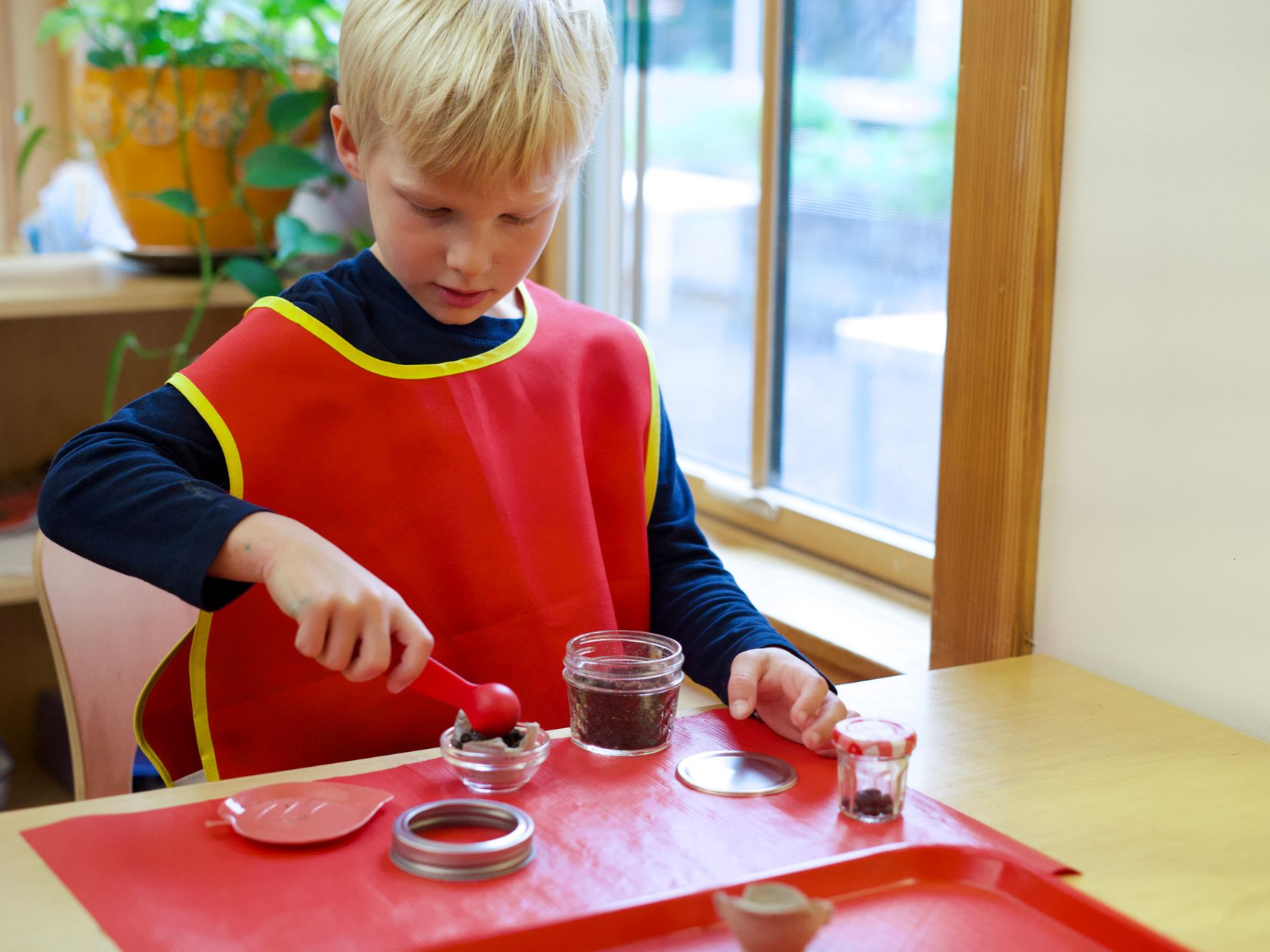
In a Montessori environment, children have a place where practical life activities are carefully prepared and presented to support emerging independence. The sink is at children’s height. The faucet is easy to turn on and off. The soap container holds just enough soap to wash hands. Children can perform activities that were perhaps previously done for them.
Practicing Self-Care
The practice of self-care can begin early in children’s lives by approaching tasks with an attitude of collaboration. Even if a baby can’t do an action, they can have a sense of participating. We can invite this participation by saying things like, “I’m going to put on your shirt. Let’s put your arm through the sleeve.” As we allow for more and more collaboration, children’s active participation gradually increases. Opportunities for collaboration can be as simple as offering something in front of a child rather than actually putting it into their hands.
Caring for Surroundings
In addition to self-care, a Montessori environment provides numerous ways for children to care for their surroundings. In order for children to be successful in this process of caring for their surroundings, we thoughtfully prepare the environment. Child-sized materials give children an opportunity to participate successfully. Their work must be real work, rather than activities to just keep them busy. Plus, the impact on the environment needs to be clear. If the plants need water, then children can water the plants. If the floor is wet, children can mop the floor. If a table is dirty, children can wash the table. Through real and meaningful activities, children develop a strong sense of belonging within a community.
Supporting Practical Life at Home
Parents often ask how to support their children’s practical life work at home. One easy and meaningful strategy is to create routines that help children care for their surroundings. They can clean up toys at the end of the day, set the table for dinner, or put dirty clothes in the laundry basket. The preparation for these kinds of activities isn’t elaborate and merely requires carefully selected items or furniture: a basket in the laundry room for dirty clothes, a special shelf for toys, or a low drawer in the kitchen prepared with items for setting the table.
When thinking about how to create practical life activities, consider the following:
1. Will the activity help develop independence and coordination of movement?
2. Can it be done independently?
3. What skills are needed?
4. Will this activity allow repetition?
5. Is it culturally appropriate and necessary?
6. Is it beautiful?
7. Is the material child-sized?
8. Is it logical?
9. Is it safe?
With these guiding questions in mind, we can create simple yet purposeful ways for our children to learn how to care for themselves, those around them, and their surroundings. In the process, children observe what is essential and then make the activities their own. Plus, as they internalize the procedure, children start to realize how capable they are! They put their whole focus into their work and experience great satisfaction in completing the activity. Meaningful engagement in practical life activities allows children to develop a strong sense of belonging and ultimately flourish into their fullest selves.
During these summer days, take a look at where your children might be able to contribute to the daily rhythms of the household, or even take more ownership of their own routines for self-care. Children will begin to imitate adult actions, which leads to them performing tasks in their own unique ways.
Keep in mind that this process is not completely linear, as some days children need more support than on other days. At this point, we can offer loving assistance while still upholding a sense of their involvement: “I see your clothes are still on the floor. Let’s pick them up together.” We all can use a little help sometimes!
From infants to adolescents, our young people are quite capable and benefit greatly from participating in practical life activities. If you would like some inspiration for how children are involved in caring for themselves, their surroundings, and others, please contact us or schedule a visit!