Montessori Basics: Cosmic Curriculum
When Dr. Montessori began developing the elementary curriculum, she knew it had to be vastly different from the work of younger children. Not only were the academic skills to be more challenging, but the manner in which content was to be delivered shouldn’t be the same. This was because she understood that in the second plane of development (ages 6-12), children’s needs are very different from the needs of their younger selves.
She coined the term cosmic education to describe the work done in the elementary years. Around age six, children’s scope of vision tends to expand beyond themselves. Social connections are suddenly far more important. Children develop vivid imaginations, and they become curious about their world, their universe, and how they fit into the big picture. Our task is to provide a framework in which they can explore those areas.
One way we tap into the wonder of the elementary mind is through what we call the Great Lessons. The Great Lessons are not synonymous with cosmic education, but rather they are a springboard from which the work can begin. These lessons are dramatic and impressionistic. They open doors in the child’s imagination from which a wide scope of learning can begin.
These key lessons are given each year. Over the cycle of time in the elementary, a child will receive these great lessons multiple times, with a different level of deepening understanding each time. The weeks and months that follow will include many related lessons, though these may vary from year to year in order to cover a range of topics and student interests.
The Beginning/The Creation of the Universe
Typically given near the beginning of the school year, this lesson is a delight for children. The guide prepares materials while the children are elsewhere: a long series of “experiments” and other props that will be used during the telling of the story.
Some versions begin with different origin stories from various cultures. Other adaptations begin with a description of the time before our universe began: how it was colder and darker than we can even imagine, and how in an instant the universe came into being. Through demonstrations, the guide shows how different particles came together and moved apart, then moves into exploration of the immense number of stars in our universe, states of matter, how quickly light travels, and how the solar system and the surface of the Earth formed over time. The lesson culminates with the eruption of a model volcano, and sets the stage for the life that was to come in Earth’s future.
Follow-up lessons and work are often related to the study of space, chemistry, physics, geology, and geography. The lesson is also a great prequel to teaching children about the scientific method and how to conduct experiments.
The Coming of Life
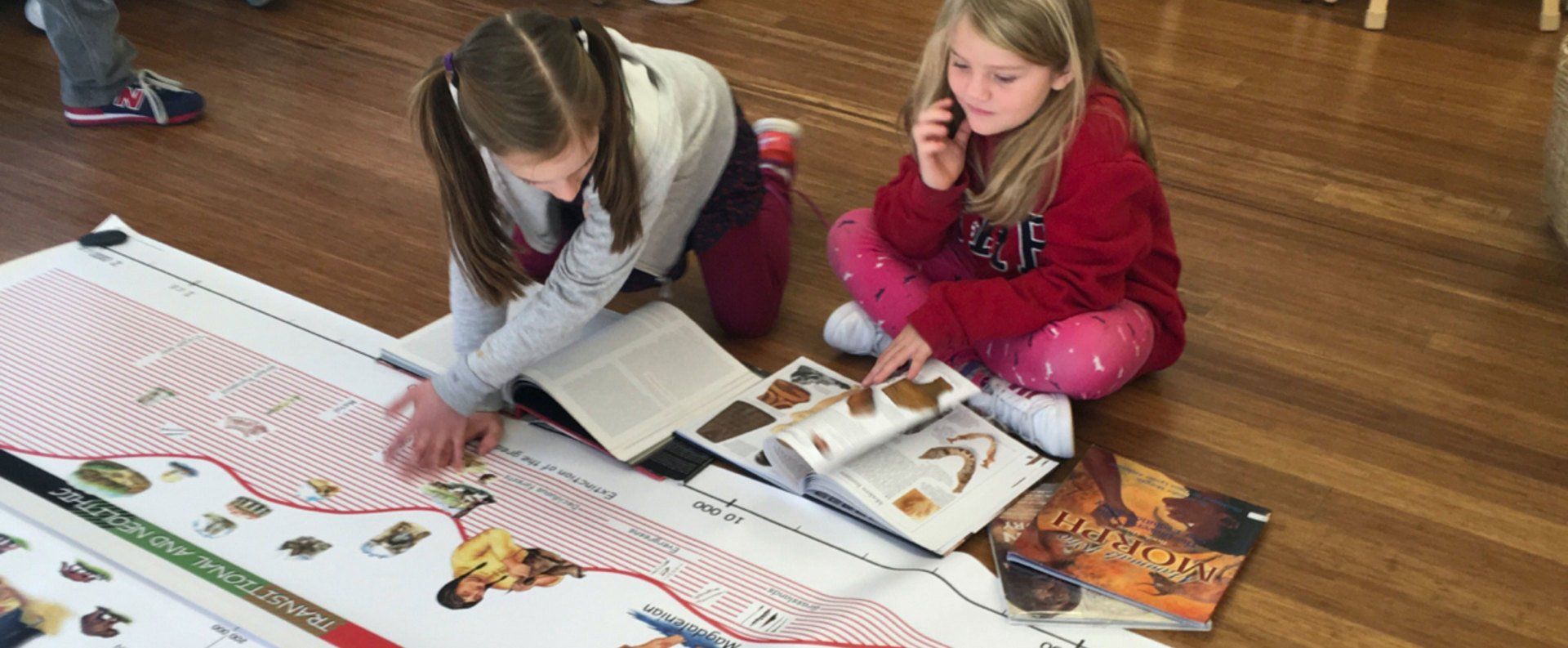
A bit later the children will begin to learn about the evolution of life on Earth. Two materials: the Long Black Strip and the Clock of Eras give children a visual sense of the amount of time Earth has been in existence compared to how long humans (and other living beings) have been here. It’s often shocking for children (and adults!) to see a long black strip of fabric (Earth’s lifespan) running the length of a long hallway or along the playground, with a tiny strip of white at one end to represent all of humanity. These types of lessons are humbling to children, and they begin to give them a sense of connection to those that have come before us.
The culmination of this great lesson, however, is the Timeline of Life. This gorgeous, colorful, illustrated material shows children just how life has evolved throughout history, from early one-celled organisms to the first plants and invertebrates, through the various vertebrates throughout time. Children in the elementary years adore this work. They learn about how fossils are our records of the past, and how our understanding of the past changes with each new discovery. (The Timeline of Life has been revised several times!)
Follow-up work includes plenty of biology content. Children learn about the five kingdoms of life. They take a close look at the classes of vertebrates, their external features, and internal body functions. Students also learn about the biology of plants, from algae and mosses to flowering and fruiting plants, and so much more.
The Coming of Humans
This great lesson also includes beautiful timelines, one impressionistic to give a sense of written language is a small part of human history, and two others that provide some dates and evidence of our evolution from the earliest hominids to the present day. Children learn about what makes humans special, and how our ability to think, feel, and work have let us make developments that are unique to our species. Students learn about the migrations humans have made across the globe and how we have used various tools and technologies to make our lives easier.
Montessori guides introduce children to the concept of the fundamental needs of humans. We discuss what those needs are and how we meet them today. One material allows children to explore how these same needs have been met by various civilizations throughout history. Learning about our past as a species is important for children in the second plane of development. It helps them develop a sense of self, and a sense of belonging in the bigger picture.
The Story of the Alphabet & The Story of Numbers
Simply put, children are fascinated to learn about the origins of letters and words, as well as math and numbers. The Story of the Alphabet gives children a framework in which they might place their own learning of language. By this time in their lives they have mastered oral language, but they are still very much engaged in the development of their own reading and writing skills. They love learning about the Phoenicians and the first real alphabet, trying their hand at hieroglyphic writing, and comparing the Greek and Roman alphabet to the letters we use today. To learn about the origins of such things is empowering and fascinating, and makes their work more special than it otherwise would be.
The Story of Numbers allows children to take a peek at how recording quantities has transformed over time. They love trying to translate different ways of writing a number and often branch out into explorations of people who have made significant contributions to our mathematical understanding. This story comes at a perfect time, as children are simultaneously learning the foundational math skills that will take them through the rest of their lives. When children are working on subtraction problems and they are able to relate it back to the beginnings of subtraction, the work is so much more meaningful and exciting for them.
If you have any questions or would like to
observe in our elementary program to see cosmic education at work, please let us know! We think you will find the experience enlightening and rewarding.